

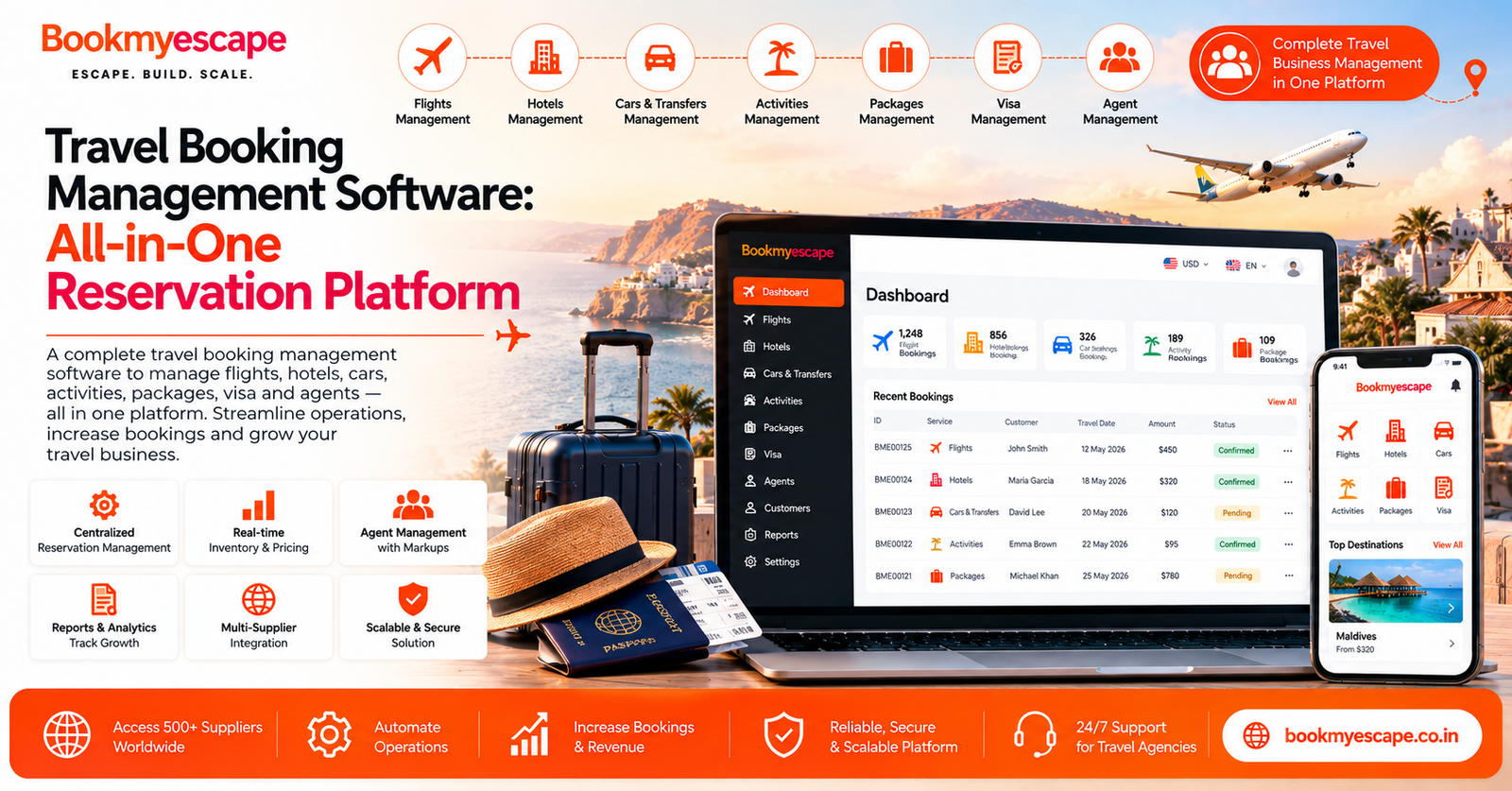
Managing travel bookings becomes complicated when every part of the process happens in a different place. Hotel reservations might sit in one supply portal flight details and another system on customer payments in separate records. When your travel requests are changed the team has to check every source before it can provide an approval. For travel agencies or tour operators these disconnected processes then slow down daily operations and make it challenging to manage growing booking volumes. Travel Booking Management Software Brings major activities like supplier connectivity reservations and payment tracking into one more organized for. The right should do way more than just help your customers search for flights or hotels. It should also help your travel business manage the complete reservation process from checking availability to handling cancellations.
When travel bookings are spread across too many systems?
If you are handling a customer ‘s holiday booking we check flight options to one platform, search for hotels to another and contact a global supplier to arrange airport transfers. Once the customer approves the quotation you need to confirm each service, collect payment and keep track of reservation details. Now the same thing you have to do with thousands of similar bookings every day. Your team has to enter customer information repeatedly, search through emails for supplier information, and manually update records whenever something changes. Even a small oversight can lead to missed updates or incorrect booking details or delays in responding to customers. These problems often appear as your travel business grows. The existing process might be manageable with a small number of bookings but it becomes challenging to maintain when several employees handle different customers and suppliers. A connected travel booking management system can help bring these activities together. Depending on the platform and integrations where employees might be able to access reservation details and manage customer information. This does not mean every task will automatically happen without human involvement. The main advantage is having a more organized process with your disconnected records.
What all in one travel management booking software actually connects?
An all in one Travel Booking Management Software connects the different parts of the travel booking workflow. Its values come from how these functions work together other than from the number of features listed in a brochure.
Travel inventory and supplier connectivity
As a travel business you might rely on suppliers to offer the products that your customers want to book. Depending on the business model this might include airlines hotel aggregators global distribution system and transfer providers. Travel APIs allow software systems to exchange information with connected suppliers stop depending on the integration a platform might Retrieve availability and submit requests. For example an agent looking for accommodation in Singapore can search connected hotel inventory for the customer dates and compare available options. If your customers Alexa suitable property the agent can proceed through supported reservation workflow.
Search pricing and reservation management
Once the supply and inventory is connected the platform helps your users search for travel products, compare options and create reservations. A typical booking workflow might include checking availability, reviewing dates and entering passenger or guest details. Keeping all these details organised makes it easier for staff to follow the reservation from the initial search to confirmation. Pricing controls are especially important for travel businesses that sell through different channels. You might apply a certain markup while the wholesaler might often negotiate rates. The system should make it clear which price applies to a booking and what conditions are attached.
Payments and financial records
Payment management is also closely linked to travel reservations, but the 2 processes are not always completed at the same time. Instead, your customer may pay for a booking while the supplier confirmation is still pending. A refund might also take time to process after the cancellation has been accepted. A travel booking management system might connect payment gateways with reservation records so that employees can review transactions alongside booking information.
Post booking service And reporting
Once a booking is confirmed your customers might still need assistance. They might request a change in travel dates or ask about cancellation charges. The travel team must be able to locate the reservation and understand the current status before responding. A well connected travel platform can help employees access booking histories and related customer information without searching through multiple applications. Reporting provides another useful layer. Your managers might need to review sales in agent activity to understand how the business is operating.
Follow one travel booking through the entire platform
The benefits of an integrated system become easier to understand when you follow a booking from beginning to end.
1. Search for travel options
You enter the destination travel dates, passenger details and other required information. The platform searches the connected suppliers and displays the relevant options returned by those systems. You can compare the available choices and prepare a quote based on customer preferences. The products shown will depend on the supplier connections and inventory available.
2. Select and validate the offer
After reviewing the quotation your customer chooses flight and hotel. Before submitting the reservation you also need to check the latest availability and pricing. This step matters because an offer displayed during the initial search might change before the customer is ready to book.
3. Process the booking and payment
You enter the required passengers or guest details and submit the reservation request. The payment process then follows the configured workflow. At this stage your bathroom should make it possible to distinguish between a payment that has been processed and reservation that has been confirmed. If your supplier response is delayed you need to clear a way to identify the pending booking and follow up.
4. Confirm and notify the customer
After required supplier confirmation is received you can provide the customer with relevant booking details. Modifications might be sent through email or other supported channels. When your holiday contains several services the team should be able to track each component separately. Confirm hotel reservation does not necessarily mean flights and transfers have also been confirmed.
5. Manage changes and financial follow up
Suppose your customer later requests a change to the hotel dates. You need to check the supplier’s conditions, confirm whether the change is possible and update the reservation through the supported process. Your team also needs to track additional charges, refunds or supplier payments. Having the booking history and relevant financial information connected can make all these tasks easier.
All-in-One Software vs. Separate Travel Booking Tools
| Consideration | All-in-one platform | Multiple connected tools |
| Daily workflow | Can bring key tasks into one interface | Staff may need to work across several applications |
| Implementation | Depends on the available modules and integrations | Each component may require separate setup |
| Flexibility | Limited to supported capabilities and customisation options | Individual tools can be selected for specific needs |
| Data consistency | Depends on how well the components are connected | Requires reliable data exchange between systems |
| Cost | May include subscription, setup and integration charges | May involve separate licences, integration and maintenance costs |
What to look for in Travel Booking Management Software?
When comparing travel booking management systems, focus on functions that solve your actual operational problems.
A booking interface that matches your sales channel
B2C Booking websites allow you to search and book services themselves. B2B Hotels are designed for agents and business partners who need access to inventory and pricing routes and their own booking records. If your business operates more than one sales channel check whether the platform supports each one.
Flexible pricing and business rules
You might use markup commissions or negotiated rates. Companies that work with sub agents might also need credit limits and different commercial terms for different accounts. Check whether the platform supports these rules and whether employees can understand how the final booking prices are calculated.
Integrations that reduce repeated work
A travel company might use separate systems for customer relationship management, accounting payment processing and supplier connectivity. Integrating all the tools can reduce repetitive data entry and help keep information consistent. You need to ask which integrations are already available and which require additional development.
Clear booking status and exception ending
Employees need to know whether a reservation is confirmed pending or failed. If the system displays and clears statuses you might have to contact suppliers manually just to understand what has happened. As the provider to demonstrate a booking where payment has succeeded but supplier confirmation is still pending.
Reporting that connects sales and operations
Reporting should help you understand both business performance and daily operation activity. Useful information might include booking volumes, cancellation costs and agent wise sales. Check whether reports can be filtered by date or supplier. It is also worth asking if data can be exported for accounting or management reporting.
How does BookMyEscape fit into the connected booking workflow?
BookMyEscape is the travel technology provider that describes solutions for travel booking systems supplier API integrations and booking platforms for different travel products. You can connect with experts to understand how the travel booking management system can help your team produce reputed work, maintain the error reservation records and manage customer requests more effectively.
Read More: Travel Management Booking Software: Features, Benefits & How It Works
FAQ’S
1. How do you manage flight, hotel, and transfer bookings in one itinerary?
Travel booking management software can help agencies coordinate flights, hotels, transfers, and other travel services through a connected booking workflow, depending on its integrations. Each service should retain its own reservation status, supplier details, payment information, and confirmation records. This helps travel teams track multi-service itineraries and identify which components are confirmed, pending, or require changes before sharing the final itinerary with customers.
2. How should travel agencies handle pending bookings?
Travel agencies should use a booking workflow that clearly distinguishes pending, confirmed, and failed reservations. When payment is successful but supplier confirmation is delayed, staff should be able to identify the outstanding booking, review its payment status, and follow up without creating a duplicate reservation. Clear status tracking helps teams resolve booking exceptions and provide customers with accurate updates.
3. Can travel booking software manage different markups for travel agents?
Travel booking software can support different markups, commissions, negotiated rates, and agent-specific pricing when these capabilities are included in the platform. This is particularly useful for B2B travel businesses that distribute inventory through multiple agents or partners. Before implementation, confirm whether pricing rules can be configured by agent or sales channel and whether the system clearly displays the final selling price and applicable commercial terms.
4. How can travel agencies track cancellations and refunds?
Travel agencies can track cancellations and refunds more effectively when reservation records, supplier conditions, payment transactions, and booking histories are connected. A centralized workflow can help staff retrieve the original booking, review applicable cancellation charges, monitor refund progress, and record financial adjustments. Because cancelling a reservation does not necessarily mean the customer has received a refund, the system should make booking status and transaction status independently visible.
5. How do multiple supplier integrations affect booking accuracy?
Multiple supplier integrations allow travel businesses to access inventory from different sources, but booking accuracy depends on how well the connections exchange availability, pricing, reservation details, and status updates. Differences between supplier systems can create inconsistencies if information is not handled correctly. Agencies should test price changes, delayed confirmations, cancellations, and modifications with their required suppliers before relying on the platform for daily operations.
6. What reports should travel booking management software provide?
Travel booking management software should provide reports relevant to daily operations and business performance, such as booking volumes, sales by agent, cancellation costs, supplier activity, and reservation status. Depending on the business model, managers may also need date-based filters and data exports for accounting or financial analysis. Useful reporting helps travel businesses identify operational issues, evaluate sales performance, and make decisions using organized booking information.