

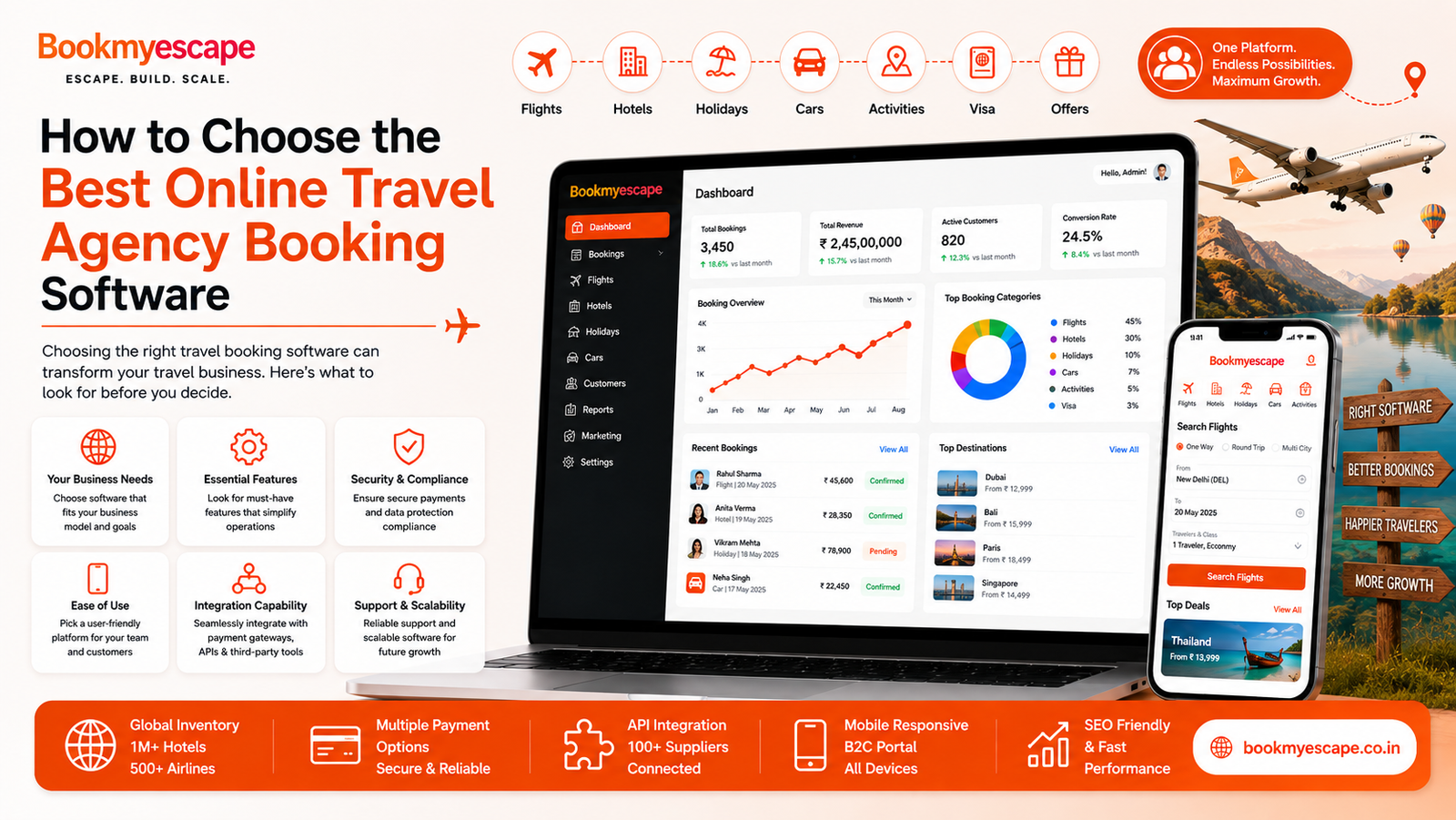
Choosing booking software can feel deceptively simple. A quick search brings up plenty of platforms with attractive interfaces and promises of helping travel businesses sell more online. But for an online travel agency the decision goes much deeper than how the booking page looks. Your Online Travel Agency Booking Software sits at the center of the business. It influences how customers search for travel, how inventory reaches your website, how payments are processed and how bookings are managed and how your team handles changes after a reservation has been made. It can also determine how easily you add new suppliers, introduce new travel products or expand into another market.
Two platforms might look almost identical from the customer site and still work very differently behind the scenes. One might connect easily with the suppliers you depend on while another could require costly work arounds. That’s why choosing the right software should not be based on screenshots or just the number of features listed on a sales page. The best software is the platform that matches your booking model supplier connectivity and long-term growth plans.
First decide what you want your booking platform to achieve
Before comparing vendors take a step back and define why you are looking for new software in the first place.
Launching an online travel business
If you are starting a new OTA you might be looking for Online Travel Agency Software That allows you to get online without spending years building every part of the booking infrastructure yourself. Your priorities might include essential travel inventory supplier connectivity and an administration system your team can learn quickly. At this stage simplicity can be more valuable than a huge collection of advanced capabilities that you won’t use for several years.
Replacing an existing booking system
If you are already operating an OTA the situation is completely different. You probably are not looking for software because you want something new. There is likely a reason that your current platform is not working anymore. Perhaps the booking process is really slow or integrations are limited or your operation team spends too much time fixing problems manually. In that case start by documenting these pain points.
Expanding an existing travel agency online
A traditional travel agency moving into online bookings has another set of priorities. You might already have stronger supply relationships and experienced staff but need a digital channel that allows your customers to search and book directly.
Your inventory strategy should influence your Online Travel booking Software choice
For OTA inventory is at the heart of the business. You might sell flights, hotels , transfers activities, car rentals and even packages. The technology supporting your business needs to reflect that product strategy.
1. Flights and GDS connectivity
Flight-focused OTAs might need access to GDS systems and airline APIs to provide relevant schedules and availability.
2. Hotels and accommodation suppliers
Hotel businesses might work with wholesalers, direct connections or other accommodation suppliers. The important consideration is whether the platform can connect with the suppliers that fit your target market and product.
3. Activities and transfers
If you want to move beyond flights and hotels activity and transfer APIs might become very important. Adding these products can help you create a more complete travel offering.
What does the customer experience look like from search to confirmation?
A customer does not experience your technology architecture. They just experienced the booking journey.
Search experience
Search needs to feel quick and simple. Your customers should be able to enter the requirements without unnecessary complexity and results should return with a reasonable time frame. Filtering also matters. When you provide hundreds of thousands of options your customers need useful ways to learn the results.
Results and comparisons
Once the results appear your customers need enough information to make a decision. Pricing should be understandable, important product details should be easy to find and comparison should not require opening 10 different pages.
Booking flow
Pay attention to how many steps are involved. Does your customer have to enter information that is not necessary? Are terms and conditions clear? Is the final price easy to understand before payment?
Payment
Payment is one of the most sensitive parts of the booking journey. Your customers need confidence that the transaction is secure. Your business needs reliable payment processing and a clear way to identify successful failed or refunded transactions.
Confirmation
After payment customers want reassurance. A good confirmation process should clearly communicate that the booking has been completed and provide the relevant Reference.
Post booking
This is where many booking platforms reveal their real strengths and weaknesses. Can your customers modify booking? Can your support team quickly find the reservation and understand the status?
What happens behind the booking screen matters just as much?
The customer sees a booking page. Your operation team sees everything that happens afterward. A booking might need supplier confirmation payment reconciliation, customer communication refund management and internal reporting. Sometimes everything goes smoothly and sometimes it doesn’t. A supplier might reject a booking or a payment might fail or just a flight might be cancelled. Your Online Travel Agency Booking Software needs to give your team a practical way to handle these situations. A visually impressive working engine is not much help if your employees have to manually repair every reservation that falls outside the standard workflow.
Don’t let pricing become the only decision maker
Cost matters but the lowest initial price is not always the lowest overall cost. When evaluating Online Travel Agency Software look beyond the subscription or the setup fees. You need to consider integration costs and transaction related charges besides additional modules and future development upgrades. There is also the cost of manual work. Suppose one platform costs slightly more but saves your operations team several hours every day because bookings and reporting are automated. That difference can have a meaningful financial impact with time. On the other hand a cheaper Online Travel booking Software that requires constant manual intervention might become expensive in ways that are not obvious during the initial purchase. This is the only reason why it’s usual to think in terms of total cost of ownership.
When should you replace your existing Online Travel Agency Booking Software?
Sometimes the problem is not that you don’t have the software. It’s that the software you already have is holding the business back. Frequent manual intervention is one warning sign. If your employees regularly have to fix bookings, update information manually or move data between systems your current platform might not be keeping up. If you cannot add suppliers or travel products you need, your technology might be restricting your commercial strategy. You should also reconsider your Online Travel Agency Software if your customers are abandoning bookings because the experience is slow or complicated, if support requests are increasing or if adding a new product or market requires development work.
Compare Software by Business Fit, Not by the Number of Features
| Evaluation Area | What to Check |
| Travel Inventory | Flights, hotels, activities, and other required products |
| Supplier Connectivity | GDS, APIs, and direct supplier connections |
| Booking Experience | Search-to-confirmation journey |
| Payments | Gateway options, security, and transaction handling |
| Operations | Booking servicing, cancellations, and modifications |
| Integrations | CRM, accounting, reporting, and other systems |
| Scalability | Users, bookings, markets, and products |
| Administration | Ease of managing the platform |
| Support | Implementation and ongoing assistance |
| Commercial Model | Overall cost as the business grows |
So you need to know that choosing the online travel agency booking software from Bookmyescape comes down to one thing: how much unnecessary friction can the platform remove from your business? For customers that means making it easier to find bookings and manage travel. For your team it means reducing repetitive work and making bookings easier to manage when something changes. The strongest platform is not always the one with the biggest feature list or the lowest price. It is the one that fits the way your OTA actually operates. Before you choose, define your goals, test the customer experience and look closely at integration and long term costs.
Read More: How an Online Travel Agency Software Improves Profit Margins
FAQ’S
1. What is online travel agency booking software?
Online Travel Agency Booking Software is a technology platform that enables travel businesses to manage online searches, travel inventory, reservations, payments, supplier connections, and post-booking services from a centralized system. It can support flights, hotels, activities, transfers, and packages while connecting with APIs, GDS platforms, payment gateways, CRM systems, and other travel technologies.
2. How does travel booking software work?
Travel booking software connects your website or booking application with travel suppliers and technology systems to create an end-to-end booking journey. Customers can search available travel products, compare options, select a service, enter traveler details, make a payment, and receive confirmation, while the travel business manages reservations, supplier communication, cancellations, modifications, refunds, and reporting through the backend.
3. What features should travel booking software have?
The most important features depend on your travel business model, but effective travel booking software should typically support travel inventory, supplier connectivity, search and filtering, booking management, payment processing, customer management, cancellations and modifications, reporting, integrations, administration, and scalability. B2B businesses may also require agent accounts, negotiated rates, markups, and partner-specific pricing.
4. How much does travel booking software cost?
The cost of travel booking software varies based on business requirements, booking volume, integrations, travel products, customization, implementation, support, and ongoing development. Instead of comparing only setup or subscription prices, travel businesses should consider the total cost of ownership, including supplier integrations, transaction costs, additional modules, maintenance, and operational savings from automation.
5. Can travel booking software integrate with APIs and GDS?
Yes, travel booking software can integrate with APIs, GDS platforms, hotel suppliers, activity providers, transfer companies, payment gateways, CRM systems, accounting platforms, and other travel technology services. The required integrations depend on the products a business sells, its target market, and its distribution strategy, so supplier connectivity should be evaluated before selecting a platform.
6. When should a travel agency upgrade its booking software?
A travel agency should consider upgrading its booking software when the existing platform creates operational or commercial limitations, such as frequent manual booking corrections, slow customer experiences, limited supplier connectivity, difficulty adding new travel products, increasing support issues, or challenges expanding into new markets. The strongest reason to upgrade is when the current system creates more friction than value for customers and internal teams.