

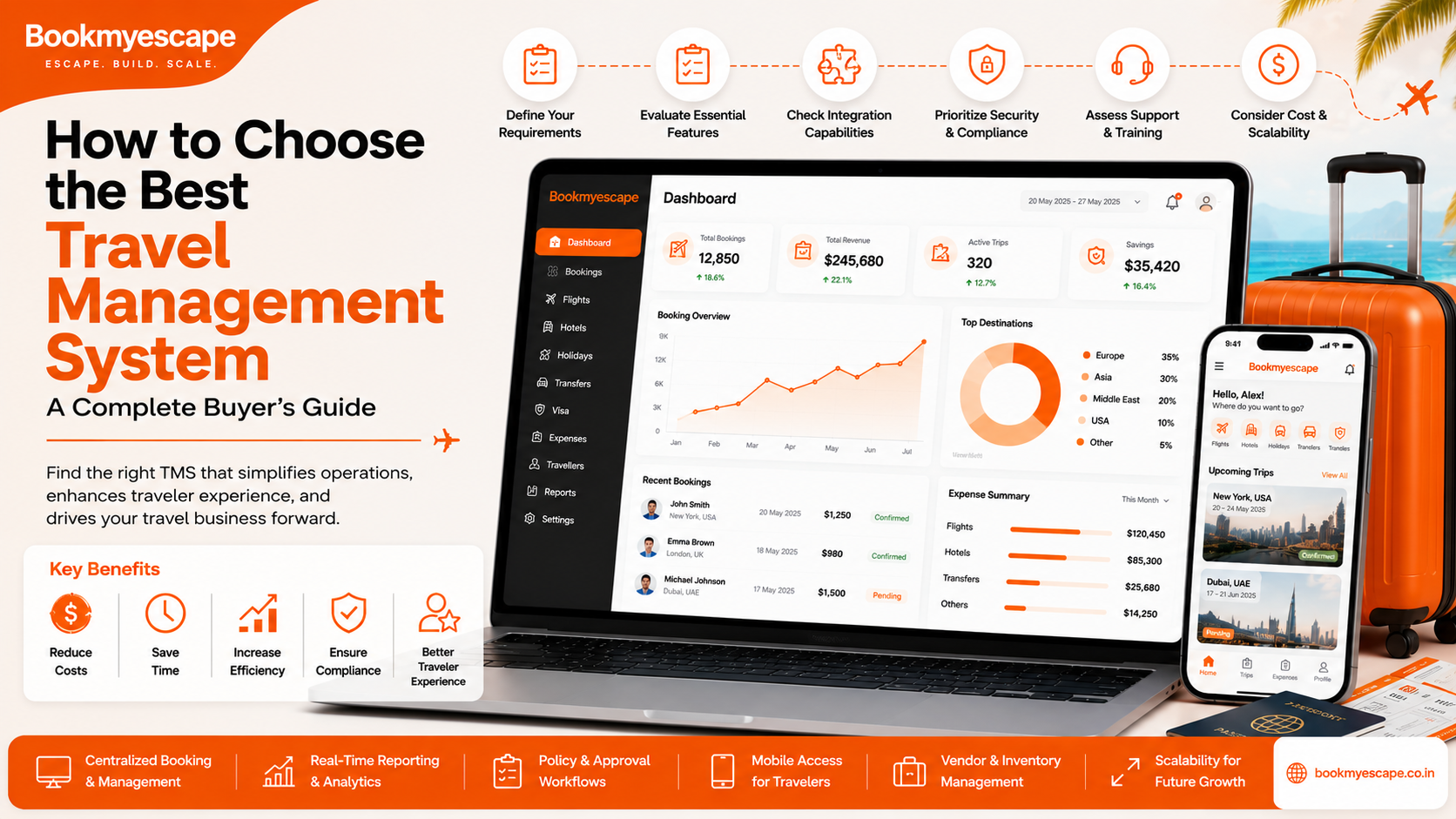
The travel industry has never had more opportunities for growth. New destinations, digital booking channels and global supplier networks have made it easier than ever for you to attract new customers. But growth also brings new challenges that you might not even expect. In the early stages managing bookings with spreadsheets and emails end messaging apps and a few different software tools might be manageable. As your business grows those processes can quickly become obstacles. More bookings mean more reservations to track. More customer requests mean your team spends more time responding.
Before long simple tasks begin taking longer information gets scattered across multiple platforms and teams duplicate work and manual processes slow down the entire business. This is often the point where you must consider investing in a Travel Management System. Choosing the right system is not simple. The market is full of platforms that promise automation, better reporting and faster bookings. Yet many businesses invest in technology only to discover that it doesn’t actually solve the day to day operational challenges. Rather than comparing long feature lists you need to understand what really matters when selecting a travel management system.
Your business doesn’t need more software-it needs fewer operational bottlenecks
When you start evaluating technology you might immediately look at features. Does the platform have multiple suppliers? Can it generate invoices? No doubt these are very important questions but they do not address the real problem. Most growing travel businesses are not struggling because they lack software, they are struggling because too much of their work depends on disconnected processes. Think about a typical day at a travel company.
A sales executive receives a customer inquiry through email while the details are copied into a spreadsheet before being entered into a booking system. Someone else contacts suppliers to confirm availability. Customer updates happen over WhatsApp while invoices are created in separate accounting software. Together all these create unnecessary friction. Some of the most common operational bottlenecks include entering the same customer information into multiple systems besides delays in preparing quotations because rates need manual verification while coordinating with multiple suppliers through emails and phone calls.
These errors rarely happen overnight. They build gradually as your business grows. Eventually, your team spends more time engaging operations than creating memorable travel experiences for your customers. That’s why many businesses begin by evaluating a travel management system. The objective is not just to digitize operations. It’s all about removing friction and improving visibility.
The Best Travel Management System Depends on the Business You’re Building
| If Your Business Priority Is… | Your Travel Management System Should Help You… |
| Faster booking operations | Automate booking and reservation workflows |
| Better customer experience | Centralize customer and booking information |
| Business growth | Scale without increasing manual work |
| Managing multiple suppliers | Keep inventory and supplier data organized |
| Better decision-making | Provide real-time reports and business insights |
| Expanding services | Support additional travel products and integrations |
1. Travel Agency
For a traditional travel agency customer relationships are often the biggest competitive advantage. Advisors spend time understanding travel preferences and suggesting destinations. Operational priorities usually include faster quotation creation and customer history management. The ideal system should reduce administrative work so that your consultants can spend more time helping your customers plan their trips.
2. OTA Platform
An OTA Platform Operates on a completely different scale. Instead of managing dozens of enquiries every day you might process hundreds or even thousands of bookings across flights, hotels and holiday packages. If you are running an OTA platform you need scalability as your first priority. You must consider managing inventory in real time delivering fast website performance and automating repetitive operational tasks.
3. Corporate Travel Company
Corporate travel involves far more than just booking flights and hotels. You need to ensure that your travel policies are followed, approvals happen quickly and expenses are tracked accurately. Operational priorities include policy compliance multi level approval workflows and centralised travel Support. An Online Travel booking system Should simplify coordination between employees travel managers and finance teams.
4. Tour Operators
As a tour operator you might manage complex travel packages that combine transportation accommodation, sightseeing and local experiences. Managing these parts manually becomes increasingly difficult as product offerings expand. The right system helps you organize the moving parts while making it easier to introduce new packages without increasing administrative workload.
Don’t choose software based on features- choose it based on daily workflows
When you start comparing different travel technology solutions it’s easy to get distracted by the feature list. One platform highlights AI capabilities, another promises hundreds of integrations. No doubt these features might sound impressive but they do not necessarily tell you how the system will perform during a busy work day. A better question is to ask will Online Travel Agency Software make my team’s daily work easier? Every travel business follows a workflow whether you’re handling 5 or 500 bookings in a day.. The journey usually looks something like this: customer inquiry quotation booking supplier confirmation payment voucher issuance and customer support.
Now think about each step. How much time does your team spend preparing quotations? How many people are involved before a booking is confirmed? Just imagine your customer requesting a family holiday package or a consultant that receives an inquiry , checks hotel availability with one supplier, compares flight options with another, prepares a quotation and sends vouchers and later answers questions before departure. Every stage requires moving between multiple tools or manually updating information.
The result is not just slower operations also increasing the chance of pricing errors and missed follow ups. This is the only reason why evaluating a Travel Management System based solely on features can be really misleading. Instead you need to evaluate habits that support your everyday options. Ask yourself can my sales team prepare quotations more quickly? Does customer information flow automatically from inquiry to booking? When your system simplifies these everyday workflows the benefits go beyond operational efficiency. Your team spends minimum time managing processes and more time building customer relationships and solving travel challenges.
The questions smart travel businesses asked before buying Online Travel booking system
Buying technology is a long term business decision and not just software purchase. The right platform should support your business for years adapting as your operations evolve. That’s why experienced travel companies don’t begin by asking which system has the most features? They start by understanding their business. Every organization has different operational challenges. Before evaluating any travel management system it’s worth taking a step back and asking a few important questions.
What processes consume most of our team’s time?
You need to look closely at your daily operations. Where do employees spend hours every week? Perhaps consultants manually compare supplier rates or the finance team spends days reconcealing payments. Identifying time consuming activities help you understand where technology can make the biggest difference and this helps you choose the right Online Travel Agency Software.
Which tasks should be automated first
Not every process needs automation. Some tasks benefit from a personal touch especially when your customers require travel advice. But repetitive activities like generating quotations or confirming bookings are often ideal candidates for automation. Priority these areas can deliver immediate operational improvements.
Will this system still work if bookings double?
A platform that works well with a few 100 bookings each month might struggle when volume increases significantly. Think beyond your current needs. If your business expands into new destinations, adds more suppliers or launches OTA Platform or hires you an additional staff will your technology continue to support these changes? Choosing a scalable solution today can help you avoid costly system replacements later.
Can every department work from one platform
You might use separate tools for sales and reservations. While each tool might perform its own function, disconnected systems often create duplicate work and inconsistent information. A well connected travel management system allows departments to access the same booking information and reduces confusion.
A travel management system should connect your business- not create more systems
As your travel business grows new software often gets added one problem at a time. Booking booking tool here or a CRM there and even just a payment gateway. At first each edition seems like the right solution. But with time these disconnected systems begin creating new challenges. Your teams copy information from one platform to another, your customer records become consistent and even the finance team works with different data than reservations. The sales team lacks visibility into booking updates while management spends hours combining reports from multiple sources. This is why integration has become one of the most important considerations when selecting an Online Travel booking system.
The information flows directly into your CRM where your sales team prepares a quotation. Once confirmed the booking connects with supplier APIs for availability and reservations. Payment is also processed securely and invoices are generated automatically. The customer experiences a smooth booking journey while your team avoids unnecessary manual work.
What separates high growth travel companies from elsewhere?
When you look at a successful travel business it’s easy to assume that your growth comes down to better technology and larger budgets. No doubt these factors can certainly help; they are rarely the main reason a business continues to grow year after year.
1. Faster decision making
Travel is actually a fast moving industry. Prices change, availability fluctuates and customers expect quick answers. When your information is scattered across different systems even simple decisions can take longer than it should. A well organized travel management system gives you access to accurate information when you need it helping them respond more quickly.
2. Better visibility across the Business
As your teams grow, managing visibility becomes more difficult. Sales operations and finance support all generate valuable information but if the information remains isolated management only sees a part of that picture. A well connected platform brings booking data and customer information together making it easier to identify trends and monitor productivity.
3. Process automation that supports people
Automation is sometimes misunderstood. Its purpose is not to replace travel professionals. The expertise, destination knowledge and personal guidance that travel advisors provide remain really valuable. Instead automation takes care of repetitive and time consuming tasks so you can focus on the work that requires human judgment and creativity.
The hidden costs of choosing the wrong platform
Selecting a new technology platform is a significant investment and you might compare pricing before making a decision. But buying should not rely on just one equation.
Duplicate work
When systems don’t communicate with each other your employees end up entering the same information multiple times. Customer details or booking information are copied from one platform to another increasing workload and risk of human error.
Lost inquiries
In a busy travel business every inquiry represents a potential booking. Without organized workflows follow ups can be delayed and customer requests might be ignored. Over time the missed bookings can have a much bigger financial impact.
Limited integrations
Many travel businesses eventually need to connect with supplier APIs and payment gateways or accounting software. Our platform with limited integration capabilities can create unnecessary manual work and make future expansion more difficult.
Expensive migration
Replacing critical software is rarely simple. Data must be transferred and employees must go through training and even daily operations can be disrupted during the transition. Selecting a scalable travel management system from the beginning can help reduce the need for costly migrations in the future.
Looking beyond today’s need: will your travel management system still fit in 3 years?
It’s natural for you to focus on your current challenges when choosing a new system. Maybe your team needs faster booking management or maybe reporting takes far longer. But before making a final decision you need to ask a different question: will this system support your business 3 years from now? Growth rarely follows a straight line. A travel agency that currently sells holiday packages might later introduce flights and cruises. An OTA platform might expand into new markets or integrate with additional suppliers. Think about future possibilities. Will the platform support additional services without requiring a completely new system. Can it accommodate a team with different roles and responsibilities? Does it offer the flexibility to integrate with emerging technologies? No doubt it’s possible to predict every technological change choosing the platform that receives regular updates and continues to evolve gives your business better flexibility.
Before making your final decision, evaluate these business factors
By the time you have shortlisted a few travel management systems it’s tempting to compare them side by side based on features and pricing alone. A travel management system becomes a part of your everyday operations so it’s very important for you to choose a platform that supports your business over the long term.
1. Ease of adoption
Even the most advanced platform will struggle to deliver value if your team finds it difficult to use. You need to look for a system with a logical interface and clear workflows.
2. Scalability
Growth should not mean replacing your technology every few years. Whether you are expanding your supply network or hiring more employees, increasing booking volume or launching an OTA platform your system should be capable of growing with your business.
3. Regular product updates
The travel industry evolves quickly. Your customer expectations change and supply technologies improve. You need to choose a platform that continues to receive regular enhancements and product updates.
So you must know that every growing travel business reaches a point where manual process begins to slow progress. More bookings demand greater visibility and stronger operational control. At that stage investing in a private management system from Bookmyescape is not simply about adapting a new technology, it’s all about creating a better way of thinking.
Read More: How an Online Travel Agency Software Improves Profit Margins
FAQ’S
1. What is the best travel management system?
The best travel management system is a scalable platform that centralizes bookings, customer data, supplier management, payments, reporting, and daily travel operations. The right solution depends on your business model, whether you operate a travel agency, OTA platform, tour company, or corporate travel business.
2. How do I choose a travel management system?
Choose a travel management system by evaluating your daily workflows, automation needs, supplier integrations, scalability, reporting capabilities, and ease of use. A good system should reduce manual work, connect departments, support future growth, and integrate with the travel APIs and business tools you already use.
3. What is an online travel booking system?
An online travel booking system allows customers or travel agents to search, compare, and book travel services such as flights, hotels, transfers, activities, and holiday packages online. Modern systems can provide real-time availability, automated confirmations, secure payments, and centralized booking management.
4. What software do online travel agencies use?
Online travel agencies commonly use OTA platforms or online travel agency software that combines booking engines, travel API integrations, CRM, payment gateways, markup management, reporting, and reservation management. These tools help OTAs automate booking operations and manage multiple travel products from a centralized platform.
5. What features should an OTA platform have?
A modern OTA platform should include real-time travel inventory, flight and hotel booking engines, supplier API integration, secure payments, dynamic pricing, markup management, multi-currency support, CRM, booking management, and reporting. It should also be scalable enough to support increasing searches, bookings, suppliers, and international markets.
6. How does travel management software reduce costs?
Travel management software can reduce operational costs by automating repetitive tasks, minimizing duplicate data entry, centralizing booking information, improving supplier connectivity, and reducing manual errors. This allows travel businesses to handle higher booking volumes efficiently without increasing administrative workload at the same rate.