

Every successful travel business has a starting point. Some begin with a small office and a spreadsheet. Others launch with a ready made booking solution that helps them get online quickly. In the early days the goal was really simple: serve your customers, generate bookings and build a reputation. For many businesses that approach works. But as your business grows things start to change. Your customers expect faster bookings, more payment options and customized travel experiences. Your team begins managing more suppliers and handling higher booking volumes and spending more time working around the limitations of your existing system than actually growing your business. At this stage technology becomes way more than just a tool. It becomes a factor that directly influences how effectively our business operates on how quickly it can grow. This often leads to an important question: should you continue using an online travel agency software or is it time to invest in a custom OTA Platform? So you need to know that the real question is whether your current technology still matches the stage or business has reached.
When a ready made Online Travel booking system makes perfect sense?
Every business does not need a custom platform from day one. In fact for many startups and small travel agencies investing in a ready made online travel agencies software is often the smartest decision. The goal at this stage is not just to build the biggest platform in the market. It’s important to validate the business idea.
1. You are launching a new travel business
When you are just entering the travel industry your priorities are usually simple. You want to establish your brand, attract your first customers and create a reliable booking process while spending months on development. A ready made solution allows you to start much faster. Instead of worrying about building technology from scratch you can just focus on marketing and customer service.
2. You have a small team
Many new agencies operate with only a few employees. Everyone handles multiple responsibilities from customer support to marketing. A simple booking system can help you keep your operations organized.
3. Your budget is limited
Building a custom platform requires a larger initial investment. If you are still testing the market the investment might not be important. Choosing a ready made solution allows you to control costs while learning what your customers actually need. Once your business grows you can actually invest more in advanced technology.
4. You need to launch quickly
Sometimes speed matters more than customization. If your goal is to just suffer within weeks instead of months, ready made software offers a practical starting point. It helps you begin generating revenue while continuing to refine your long term strategy.
The warning signs that your current software is holding you back
You might not even realize that you need a custom platform. Instead you start noticing that everyday tasks are becoming more difficult. The software that once helped you grow starts creating new challenges.
Your team is still doing manual work
Your software was supposed to save time but your staff still copy customer information between systems and manually update bookings. Instead of reducing workload the technology creates extra steps. When this happens it’s often a sign that your current solution has reached its limit.
Customers are asking for features you cannot offer
Modern travellers expect convenience. They might ask you for flexible payment options or loyalty rewards and multi currency support. If your software cannot support these queries or customers might choose competitors who can. Customer expectations continue to evolve so your technology should also evolve.
You’re managing too many separate systems
One tool manages flights, another handles hotels. A separate platform processes payments. Reports require spreadsheets. When employees constantly switch between different systems productivity decreases and mistakes become more likely. A disconnected technology stack often creates more work.
You are missing business opportunities
No doubt you want to launch holiday packages or introduce corporate travel services. Maybe you would like to enter international markets. If your current software prevents these opportunities the limitation is not just your business it’s your technology. One missed opportunity might not seem significant.
Why growing travel businesses start thinking like product companies
There’s an interesting shift that happens as a successful travel business grows. They stop thinking about selling travel, they start thinking about building a platform.
1. Owning the customer journey
You might entirely depend on 3rd party marketplaces and have limited control over customer partnership. Growing companies want customers to remember their brand, not just the destination they booked. Owning the booking experience helps you strengthen customer loyalty.
2. Building a recognizable brand
Recognizable travel brands are not built through pricing alone. It’s built through consistent customer experiences. A booking platform designed around your business allows you to create an identity that your customers remember and even trust.
3. Create better booking experiences
Every travel business serves different customers. Some focus on luxury holidays while others specialize in corporate travel. A growing business wants technology that reflects those unique strengths rather than just forcing everyone into the same booking process.
What changes when you move to custom Online Travel Agency Software
Greater operational control
Instead of adapting your business to fit existing software your platform is designed around your own workflows. This creates smoother operations and better flexibility as your business grows.
Faster innovation
Travel trends change constantly. A custom platform allows you to introduce new services booking process and payment options or even customer experiences without waiting for 3rd party software updates.
Better partner management
As supplier relationships increase, managing them through 1 centralized platform becomes far more efficient. Your team spends minimum time switching between systems and more time building valuable business partnerships.
More customized customer experiences
A custom OTA Platform Allows you to tailor recommendations, loyalty programs and promotions based on your customer preferences. Customization also improves customer satisfaction while encouraging repeat bookings.
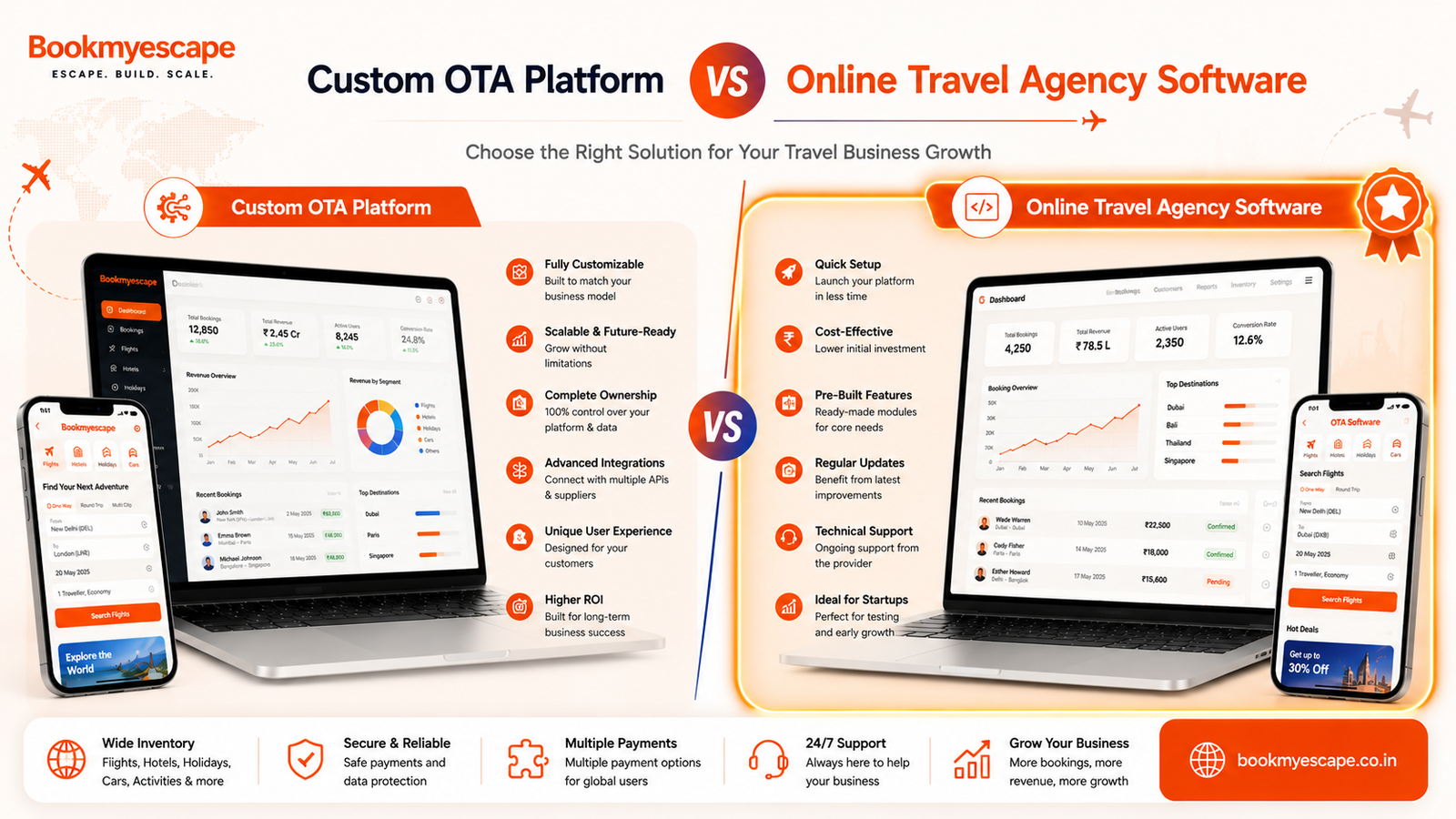
Custom OTA Platform vs Online Travel Agency Software: Which Fits Your Business Stage?
| Business Consideration | Online Travel Agency Software | Custom OTA Platform |
| Best For | Startups, new agencies, and businesses testing the market | Growing travel businesses with long-term expansion plans |
| Time to Launch | Faster deployment with ready-made functionality | Longer development time but tailored to business goals |
| Initial Investment | Lower upfront cost | Higher initial investment with greater long-term flexibility |
| Business Flexibility | Limited to built-in features and workflows | Designed around your exact business processes |
| Brand Experience | Standard layouts and customer journeys | Fully customized user experience that reflects your brand |
| Operational Control | Depends on the software provider | Complete control over workflows, integrations, and business rules |
| Scalability | Suitable for early growth but may become restrictive | Built to support increasing bookings, suppliers, and markets |
| Adding New Services | May be limited by the platform’s capabilities | Easily expand into flights, hotels, transfers, activities, insurance, visa services, and more |
| API Integrations | Usually supports selected integrations | Can integrate with multiple travel APIs, payment gateways, CRM, ERP, and other business systems |
| Customer Personalization | Basic personalization features | Advanced personalization based on customer behavior and business strategy |
| Long-Term Cost | Lower initially, but upgrades or migration may become expensive later | Higher upfront investment but often delivers better long-term business value |
Looking beyond today’s needs will your technology still work three years from now?
When choosing technology you might just focus on solving today’s problem. You want to process bookings faster, reduce manual work and even launch a new website. No doubt these goals are very important but it’s also important to ask a bigger question: will your platform still support your business three years from now? The travel industry changes quickly. Customer expectations evolve, suppliers introduce new technologies and businesses expand into new markets. If your platform cannot adapt, growth becomes much harder than it should be.
1. Expanding into new destinations
You might begin by serving one city, one country or even 1 region. As demand grows you naturally want to expand into new destinations. That means working with more suppliers offering more products and also managing a larger database. Your technology should make this expansion easier and not force you to redesign your entire system every time your business grows.
2. Adding more travel services
Very few successful travel businesses rely on one product forever. You might begin with flights but later decide to add hotels and airport transfers. Flexible Online Travel booking system Makes it easy for you to introduce these services gradually without disrupting your existing operations.
3. Growing B2B and B2C
You might just start by serving direct customers. As you grow you might introduce B2B services for travel agents or corporate clients. Supporting different customer types requires flexible pricing and booking workflows. Planning for both B2C and B2B growth early makes expansion much smoother.
4. Supporting multiple languages and currencies
Travel is a global business. If international expansion is a part of your future the platform should be ready to support different languages and currencies. These capabilities make it easier to serve customers from different markets without creating separate systems for each region.
The real cost of staying with the wrong solution
You might delay upgrading your technology because your existing system still works. The problem is that the costs of staying with the wrong solution are often hidden.
Missed revenue opportunities
Every time your system prevents you from launching a new service or adding a new supplier your business loses potential revenue. Perhaps your customers are also asking for holiday packages and flexible payment options but your software cannot support them. Those missed opportunities add up with time.
Slower daily operations
When your team spends hours handling tasks that could be automated, productivity naturally suffers. Your employees become busy managing operations instead of focusing on customer relationships and business development.
Employ frustration
Technology affects their internal team just as much as your customers. When your employees constantly switch between different parts, repeat the same tasks or work around software limitations, frustrations just grow. A smoother workflow improves productivity and job satisfaction.
Every technology decision shapes the customer experience
Your customers rarely think about the software behind your booking platform. What they notice is how easy or difficult it is to book with you.
1. Fast search results
Travelers want to find flights and hotels quickly. A fast search result creates confidence and encourages your customers to continue exploring. Even small delays can increase the chance of abandoned bookings.
2. Transparent pricing
Your customers expect the price they see during search to remain consistent throughout the booking process. Unexpected charges or changing prices create frustration and reduce trust.
3. Simple booking process
Complicated forms, unnecessary steps and confusing navigation often cause customers to leave before completing the booking. A simple booking journey makes it easier for your travelers to finish the reservations.
Don’t choose software: choose the business you want to build
You might ask what software we should buy? A better question is what kind of travel business do we want to build? Where do you see your business in three to five years? Will you remain a local agency or do you plan to serve customers internationally? Your answers should guide your technology decisions. Growth often brings new requirements, higher working volumes and even additional suppliers. Choosing technology that supports these possibilities reduces future redevelopment.
Every travel business grows at its own pace. Some remain small and highly specialized while others expand into new destinations, introduce additional travel services and build strong customer communities with time. No matter where your travel businesses are today , technology should support the journey rather than just hold its back. A ready made OTA Platform can be the right choice for you if you want to launch quickly, validate your ideas and manage operations effectively during the early stages. But as your business grows the need for greater flexibility and deeper integrations and scalable operations often becomes more important. That is exactly where a custom OTA platform can create long term value by giving your business greater control over technology and customer experience. Connect with experts today at Bookmyescape and get started.
Read More: How an Online Travel Agency Software Improves Profit Margins
FAQ’S
1. When should a travel business switch to a custom OTA platform?
A travel business should consider switching to a custom OTA platform when its existing software can no longer support business growth, automation, multiple supplier integrations, advanced customer experiences, or expanding B2B and B2C operations. If manual work, limited customization, or scalability issues are slowing your business, a custom platform can provide greater flexibility and long-term operational efficiency.
2. Is custom OTA software better than ready-made travel software?
Neither option is universally better—it depends on your business stage. Ready-made travel software is ideal for startups that need a fast and affordable launch, while a custom OTA platform is better suited for growing travel businesses that require complete control over workflows, branding, integrations, automation, and future scalability.
3. Can a custom OTA platform support both B2B and B2C travel business?
Yes. A custom OTA platform can be designed to support both B2B and B2C business models from a single system. It allows travel companies to manage different pricing structures, agent portals, customer portals, supplier integrations, commissions, and booking workflows while maintaining centralized operations and reporting.
4. Why do growing travel companies build their own OTA platform?
Growing travel companies build their own OTA platform to gain full control over customer experience, integrate multiple travel APIs, automate business processes, strengthen their brand identity, and quickly introduce new travel products. A custom platform also reduces dependence on third-party software limitations and supports long-term digital growth.
5. Can I upgrade from ready-made OTA software to a custom platform later?
Yes. Many travel businesses begin with ready-made OTA software to validate their business and later migrate to a custom OTA platform as booking volumes, supplier networks, and customer expectations increase. Planning this transition early helps minimize operational disruptions and provides a smoother migration path for future growth.
6. What are the long-term benefits of a custom OTA platform?
A custom OTA platform offers long-term advantages such as unlimited scalability, personalized customer journeys, deeper travel API integrations, advanced automation, stronger security, multi-language and multi-currency support, improved operational efficiency, and the flexibility to adapt as your travel business expands into new markets and services.