

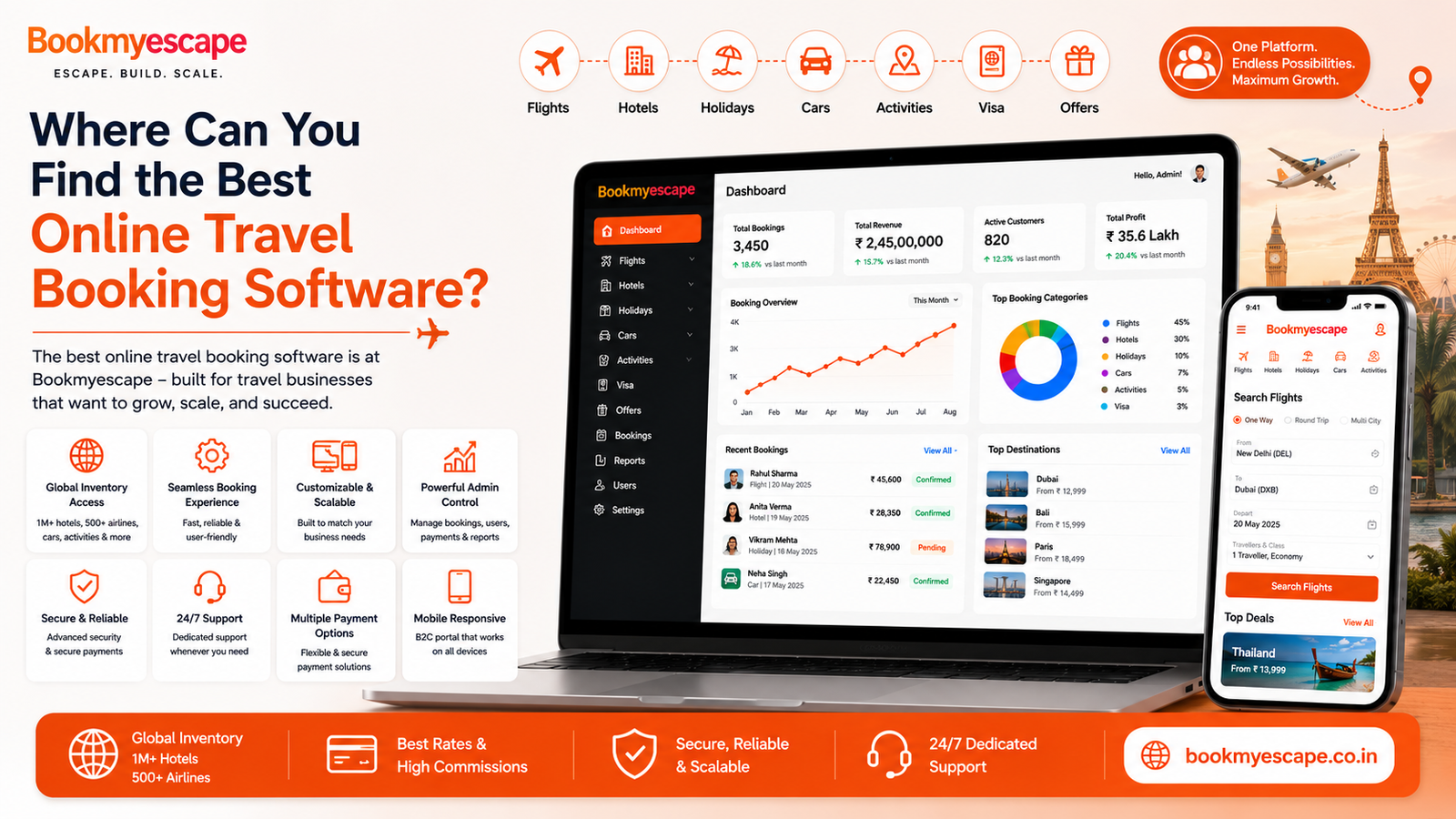
Finding travel booking software is not especially difficult anymore. Search online and you will quickly find software companies, platforms booking engines and travel technology providers all promising to make your travel business more efficient. The harder question is which one actually fits your business? A newly launched travel agency does not have the same requirements as an established OTA. A tour operator might need strong package and identity management while a DMC might care more about supplier coordination and partner workflows. A B2B business might be far more concerned with the customer booking experience. That’s why choosing the best Online Travel booking Software should not start with the list of the most popular providers. It should start with understanding how your business sales travel, where your current processes are slowing you down and what you expect the business to look like in a few years.
Where should you actually look for Online Travel Agency Software?
There is not only one place where every travel business should search.
1. Specialized travel technology providers
For most established travel businesses specialized travel technology providers are a good place to start. These companies understand that travel booking is more complicated than simply putting a reservation from on a website. A proper Online Travel booking system might need to connect with GDS systems hotel APIs bed banks CRM platforms and accounting systems. It might also need to support direct customers with multiple currencies and different pricing rules.
2. Software comparison platforms
No comparison websites can also be useful during the research stage; they are especially helpful when you are trying to understand the market rather than choosing a final provider. The limitation is that a software listing rarely tells you everything you need to know about a travel platform. 2 systems might both advertise online booking for example while offering very different supplier connectivity and support models.
3. Direct vendor websites and product demos
Once you have identified potential providers you can go directly to their websites and look beyond the marketing language. You can read the product information, look at available integrations and understand the implementation process. Check whether documentation is available where relevant and most importantly, request a demo.
A booking website is not the same as an online travel booking system
The distinction is very easy to overlook. A website can present your travel business services and even some travel products. But that doesn’t automatically make it an Online Travel booking Software. A proper booking system needs to support a transaction itself. The customer might need to search, check availability, compare options, select a product, enter travel details, pay and receive confirmation. That’s a completely different level of functionality from simply displaying a travel product with a book now button. The difference becomes even more important after the booking. What happens if your customer wants to cancel? Whatever the supply changes availability. These questions help you understand whether you are looking at a genuine travel booking system or simply a website with some reservation facility.
What should be inside a serious Online Travel Agency Software?
Rather than looking for the longest feature list, think about the capabilities your business actually needs.
Travel inventory and supplier connectivity
Your booking platform is only useful if it can provide the travel products your customers want to buy. Depending on your business this might include flights, hotels activities, transfers packages or other services. Your software should be able to connect to the relevant suppliers through appropriate APIs and connections. If you sell hotels but the platform has weak hotel connectivity its attractive interface won’t solve your problem.
Booking and reservation management
The booking journey should be clear from the very beginning. Your team needs to know what was booked when it was booked and how it was paid for. Good booking management also matters after the sale. Cancellations or modifications are all part of the booking cycle.
B2B and B2C distribution
You might sell directly to travelers while others sell through travel agents. If your business operates multiple sales channels the platform should support the workflows you actually use. B2B Operation might need agent accounts, partner specific rates and markups. B2C Business might put more focus on customer registration online payments and direct bookings.
Payments and financial workflows
Payment is not just a checkout button. You need to think about payment methods, current refunds invoices and reconciliation. You need to ask whether the platform integrates with the payment providers your customers use and whether your finance team can easily access the information it needs.
The integration question: where does your Online Travel booking system get its inventory?
This is one of the most important questions you can ask. A booking engine does not magically create flights or activities. It needs access to travel inventory from somewhere. Depending on your business that could involve gds platforms airline APIs bed banks activity providers and direct suppliers. You might also need integrations with payment gateways, accounting platforms, notification services and other business tools. The important idea is simple: the booking engine is as useful as the travel ecosystem connected behind it. Imagine finding a beautifully designed booking platform only to discover that it does not connect with the water suppliers you actually need. Those limitations can become expensive as your business grows.
What to test during an Online Travel booking Software demo
A demo is an opportunity to stop listening to the sales pitch and start testing the product. You need to ask the provider to show you how quickly a user can search and how the results are displayed. Can your customers compare options easily? Then move beyond the initial booking. Ask what happens when the payment fails. How does your customer see when a booking cannot be confirmed? How are refunds tracked? Don’t judge software from screenshots. You should also look at the back end. Test the workflow. A system can look fantastic in a presentation and still feel frustrating when our employee has to use it everyday.
The hidden difference between cheap travel software and good travel software
Price obviously matters especially for a startup or a growing agency. But looking only at the initial cost can create a lot of problems later on. A cheaper platform might require more manual work. It might also have limited integrations. Your team might need additional tools to fill gaps. Support might also be slower. Adding a new supplier might require expensive development. All of that costs add up. You need to consider the total cost rather than only the subscription or implementation price. A slightly more expensive platform that saves your employees hours every week provides better supplier connectivity, reduces booking errors and scales with the business could ultimately be the more economical choice. The goal is not to spend more.
Don’t search for the best software until you know what you are selling
This is where many software searches go wrong. You might start by asking which travel booking system is the best? Before deciding what the system actually needs to do. Your business model to determine your shortlist.
| Travel Business | What the Software Should Prioritize |
| Travel Agency | Booking efficiency and customer management |
| OTA | Scalable online booking and supplier connectivity |
| Tour Operator | Packages, itineraries, and inventory |
| DMC | Supplier and partner management |
| B2B Travel Company | Agent accounts, pricing, and distribution |
| B2C Travel Business | Customer experience and direct bookings |
There is no single platform that deserves to be called the best online travel booking software for every travel business. A small travel agency might prioritize ease of use and customer management. A tour operator might care more about packages and itinerary management. That’s why popularity should not be the deciding factor. The better question is can this system support the way my travel business sells, operates and plans to grow? Start by understanding your business model, identify the problems you want the software to solve and test the complete booking journey. And most importantly don’t choose a platform simply because it looks impressive during a sales presentation. To learn more about which platform you should choose you can connect with experts at Bookmyescape.
Read More: B2B Travel Portal vs B2C Travel Portal: Key Differences
FAQ’S
1. What is online travel booking software?
Online travel booking software is a digital platform that allows travel businesses to offer search, comparison, booking, payment, and reservation management through an online channel. Depending on the business model, it can support flights, hotels, activities, transfers, holiday packages, and other travel services through supplier and API integrations.
2. How does an online travel booking system work?
An online travel booking system connects your customer-facing booking interface with travel inventory, supplier APIs, payment gateways, and booking management tools. Customers can search available travel products, compare options, select their preferred service, provide traveler details, complete payment, and receive booking confirmation through the connected system.
3. What features should travel booking software have?
Important capabilities include travel inventory and supplier connectivity, search and availability management, booking and reservation management, payment integration, cancellation and modification workflows, and B2B or B2C distribution. The right feature set depends on whether you operate a travel agency, OTA, tour operator, DMC, B2B travel company, or B2C travel business.
4. How do I choose the best travel booking software?
Start by identifying your business model, travel products, target customers, sales channels, and growth plans before comparing providers. During a software demo, test the complete booking journey from search and comparison to payment, confirmation, cancellation, refunds, and backend operations rather than judging the platform only by its feature list or presentation.
5. What is the difference between a booking website and a booking system?
A booking website mainly presents your travel business and products, while a complete online travel booking system supports actual transactions and reservation workflows. A proper system can allow customers to search availability, compare options, enter traveler details, make payments, receive confirmations, and manage post-booking activities such as cancellations or modifications.
6. How much does travel booking software cost?
The cost of travel booking software depends on factors such as business requirements, integrations, travel inventory, customization, payment systems, user types, and ongoing support. Instead of comparing only subscription or development prices, travel businesses should evaluate the total cost of ownership, including manual work, additional integrations, maintenance, and scalability.