

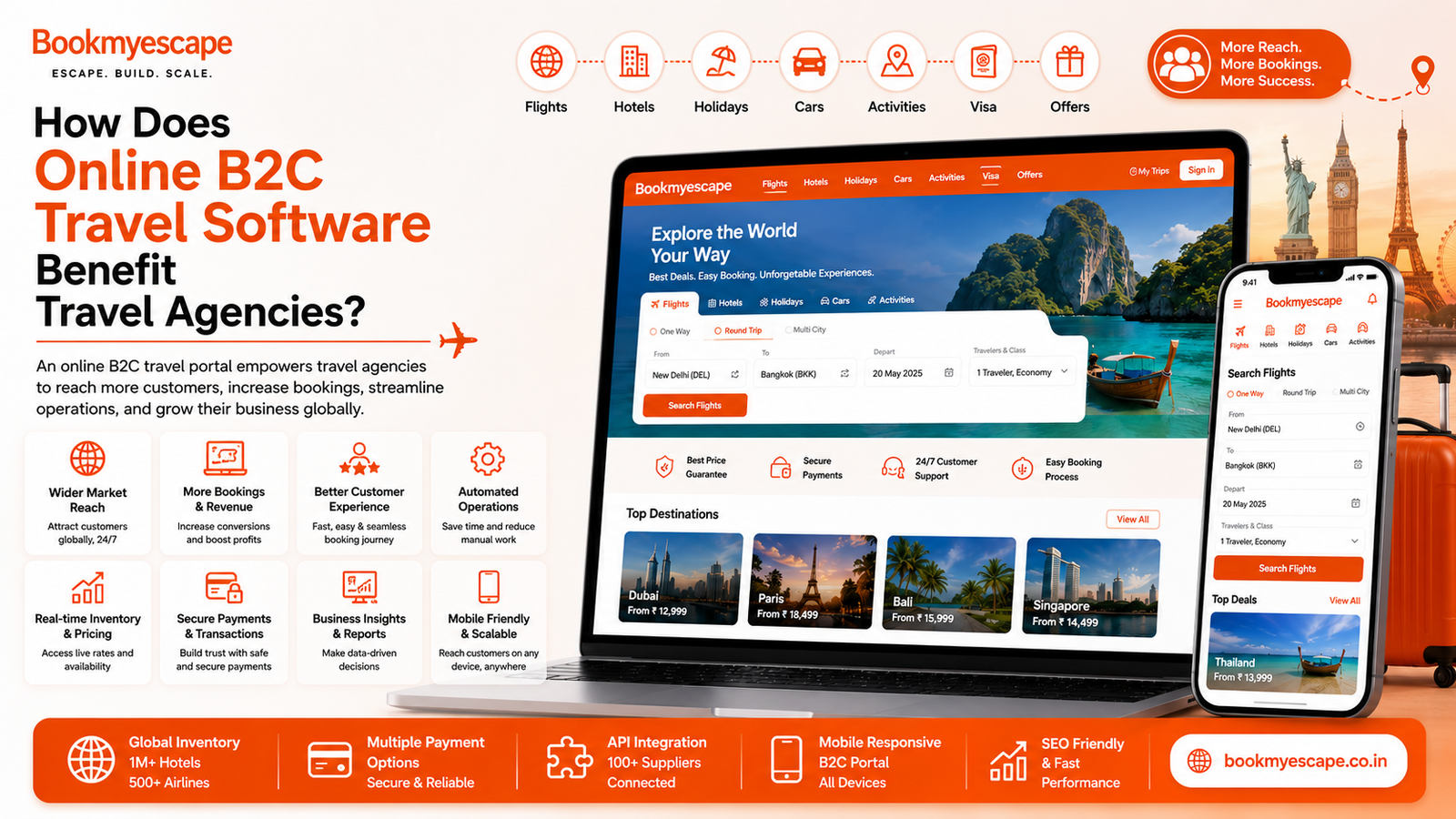
Travelers today rarely start their trip planning by walking into a travel agency. More often they begin online. They just compare flights, check hotel prices, explore destinations, read reviews and look at different travel options before deciding what they actually want. By the time they speak to an agent they might even already have a shortlist or sometimes they simply need help turning their ideas into a workable itinerary. This change in customer behaviour doesn’t mean that you are becoming less important as a travel agency. It means your customers expect travel businesses like yours to be available in more than one way. They want the convenience of online booking for a simple trip but they still value expert advice when a journey becomes complicated. This is exactly where B2C Travel Portal can make a big difference. It gives you a direct digital channel where your customers can search, compare and pay online while the agency’s team can continue handling complex and high value travel requirements.
What changes when a travel agency opens a direct booking channel?
Think about the traditional booking journey. Your customer contacts you, explains what they need, and waits while you search for suitable options. Then you prepare a quotation, send it to your customer, answer questions and make changes and confirm the booking and arrange payment. The problem is that the same process is used for every booking including simple hotel stays, standard flights or airport transfers. Your employees can end up spending a large part of their day handling transactions that your customers could easily complete themselves. A B2C Travel Software changes the dynamic. Instead of every customer starting with an employee they can search for travel products directly, compare available options and select what suits them. The process becomes more like a modern digital booking journey.
That doesn’t mean 2 approaches have to compete. You can use both as a modern travel agency. Customers who know what they want can book online while customers planning a complicated itinerary then still speak to your team. In fact the hybrid approach can be more valuable because it allows your team to spend minimum time processing routine bookings.
Online travel b2c portal Doesn’t just put your agency online it changes how you sell
Putting a booking portal on your website might look like a technology upgrade but the bigger change is commercial. Your agency is no longer limited to selling when someone calls or walks through the door. Your customers can discover and interact with your business through a digital channel whenever they are ready to travel.
1. From inquiries to always available sales
A physical travel office has opening hours. Your online booking channel doesn’t have to. Your customer might decide to search for hotels late at night, compare flights during a lunch break or start planning a holiday over the weekend. If they have to wait until your team is available before they can even begin the booking process there is always a possibility that they can move on to another website. An online portal gives them somewhere to start immediately. They can browse your available products and potentially complete a booking outside normal office hours. This does not guarantee more sales by itself because pricing and inventory still matter.
2. From manual quotations to self service discovery
Quotation work can consume a surprising amount of time in a travel agency. Your customer might simply want to know what hotels are available in a particular destination or how much light costs for certain dates. The agent then has to search, compare and prepare the information. B2C technology can move the initial discovery stage to the customer. They can explore options before deciding whether they need assistance.
3. From one time transactions to ongoing engagement
your customer relationship should not disappear after the booking is confirmed. A well connected platform can continue to provide booking information confirmations and itinerary details. Over time this gives you another way to stay connected with your customers. Someone who books a hotel today might return later for flights or activities. The portal therefore becomes more than just a booking page.
4. From a local reach to a wider customer market
A traditional agency naturally has a local footprint. Most customers might come from the surrounding area or from referrals. An online channel can extend that reach. Someone living in another city doesn’t need to visit your office to discover your business or make a booking. They can find your website, explore your services and also interact with your agency digitally. That doesn’t mean every agency needs to become a global travel marketplace.
The revenue opportunity behind an online B2C Travel Portal
The commercial opportunity is not simply about getting more bookings. It comes from giving your customers more convenient ways to buy from your agency. Direct online bookings can be especially useful for simple products like hotels, flights , activities transfers and standard holiday packages. Instead of every transaction requiring a sales employee your customers can complete suitable bookings themselves. There is also an opportunity to capture demand outside normal work hours. Customers don’t plan their trips according to your working schedule so having an online channel means your agency remains available whenever they are researching. Cross selling can be another opportunity. Your customer booking flight might also need a hotel. Someone booking a hotel might also need an airport transfer. The key is relevance. Good cross selling feels like useful travel planning not a stream of unrelated offers. A B2C Travel Software Can help you reach new customer segments. People who would never visit a physical branch can still discover your business through its original presence and become your customers.
What makes an online travel b2c portal useful to customers?
From a traveller’s perspective technology behind the portal is largely invisible. They do not care how many APIs are connected or how complicated your backend architecture is. They care whether the booking process is easy or not. The search should be very simple. Pricing should be clear, available options should be easy to compare and the website should work properly on mobile devices. Where supplier connectivity allows it your customers should also receive current availability and pricing. Nobody wants to spend 10 minutes choosing a hotel only to discover that the room is no longer available. Confirmation is also very important. After payment your customer should quickly understand that the booking has been completed and know where to find their booking reference and travel documents.
How B2C Travel Software connects with the rest of your travel business?
An online travel b2c portal should not become another isolated system that your employees have to manage separately; ideally it should connect with the wider technology environment of the agency. Your customer sees one booking experience but several systems might be working together behind the scenes. Travel APIs and supplier connections provide inventory. Payment technology processes transactions; CRM systems help manage customer relationships. Communication tools send confirmations and updates. When these systems communicate properly your employees don’t have to copy the same information from one system to another. That can reduce manual work and make the operation easier to manage as your bookings volume increases. This is why digital transformation should not be viewed simply as putting a booking engine on a website.
B2C Travel Portal: Customer Support vs Self-Service
| Customer Need | B2C Portal | Travel Expert |
| Simple hotel booking | Yes | Optional |
| Standard flight booking | Yes | Optional |
| Complex multi-city trip | Initial research | Yes |
| Group travel | Initial research | Yes |
| Corporate itinerary | Basic booking | Yes |
| Special requirements | Initial self-service | Yes |
| Complex changes | Initial support | Yes |
Where is B2C travel software heading next?
B2C travel technology is moving beyond basic search and booking. The next stage is likely to focus more on helping customers discover and customize their trips. AI-assisted travel disk could help your customers find destinations or products based on their interests and budgets. Personalised recommendations could make the booking experience more relevant while smarter cross selling could suggest useful additions at the right moment. Customer communication is also becoming more connected. Instead of treating confirmation as the end of the journey agencies can use digital channels to keep your customers informed before and during the trip.
So a B2C travel portal gives your private agency something traditional offline operations cannot provide on their digital sales channel that your customers can access whenever they are ready to research and book. But the real value is not simply putting a book now button on a website. It’s also about bringing together B2C travel software and connected operations so that each part of the business does what it does best.
Read More: Where to Find the Best B2C Travel Portal Software Options?
FAQ’S
1. What is a B2C travel portal?
A B2C travel portal is an online booking platform that allows travelers to search, compare, and book travel services directly from a travel agency or travel brand. It can provide access to products such as flights, hotels, activities, transfers, and holiday packages while allowing customers to complete suitable bookings without contacting an agent for every transaction.
2. How does B2C travel software work?
B2C travel software connects your customer-facing booking experience with travel inventory, payment systems, and internal operations. Customers can search for travel services, compare available options, select products, make secure payments, and receive booking confirmations, while connected APIs and backend systems handle availability, pricing, reservations, and related booking processes.
3. What are the benefits of a B2C travel portal?
A B2C travel portal can help travel agencies create a direct online sales channel where customers can research and book travel at their convenience. It can reduce manual work for routine bookings, support bookings outside office hours, improve the online customer experience, expand digital reach, and create opportunities to sell related services such as hotels, flights, activities, and transfers.
4. Can a travel agency use B2C and offline booking together?
Yes, a travel agency can combine online self-service booking with expert assistance for more complex travel requirements. Customers can independently book straightforward products such as hotels, flights, or transfers through the B2C portal, while travel agents can continue handling group travel, complex itineraries, special requirements, and other bookings that benefit from personalized support.
5. What features should a B2C travel portal have?
A B2C travel portal should provide a simple search and comparison experience, clear pricing, real-time availability where supported by suppliers, secure online payments, mobile-friendly design, booking confirmations, and access to travel documents. Supplier and travel API integrations can also help connect flights, hotels, activities, transfers, and other travel inventory within the booking platform.
6. Can B2C travel software increase direct bookings?
B2C travel software can create more opportunities for direct bookings by allowing customers to search and reserve travel services directly through an agency’s digital channel. By making booking faster, reducing unnecessary steps, supporting mobile users, and keeping the agency available beyond traditional office hours, a well-designed B2C portal can help capture customers who prefer self-service online booking.