

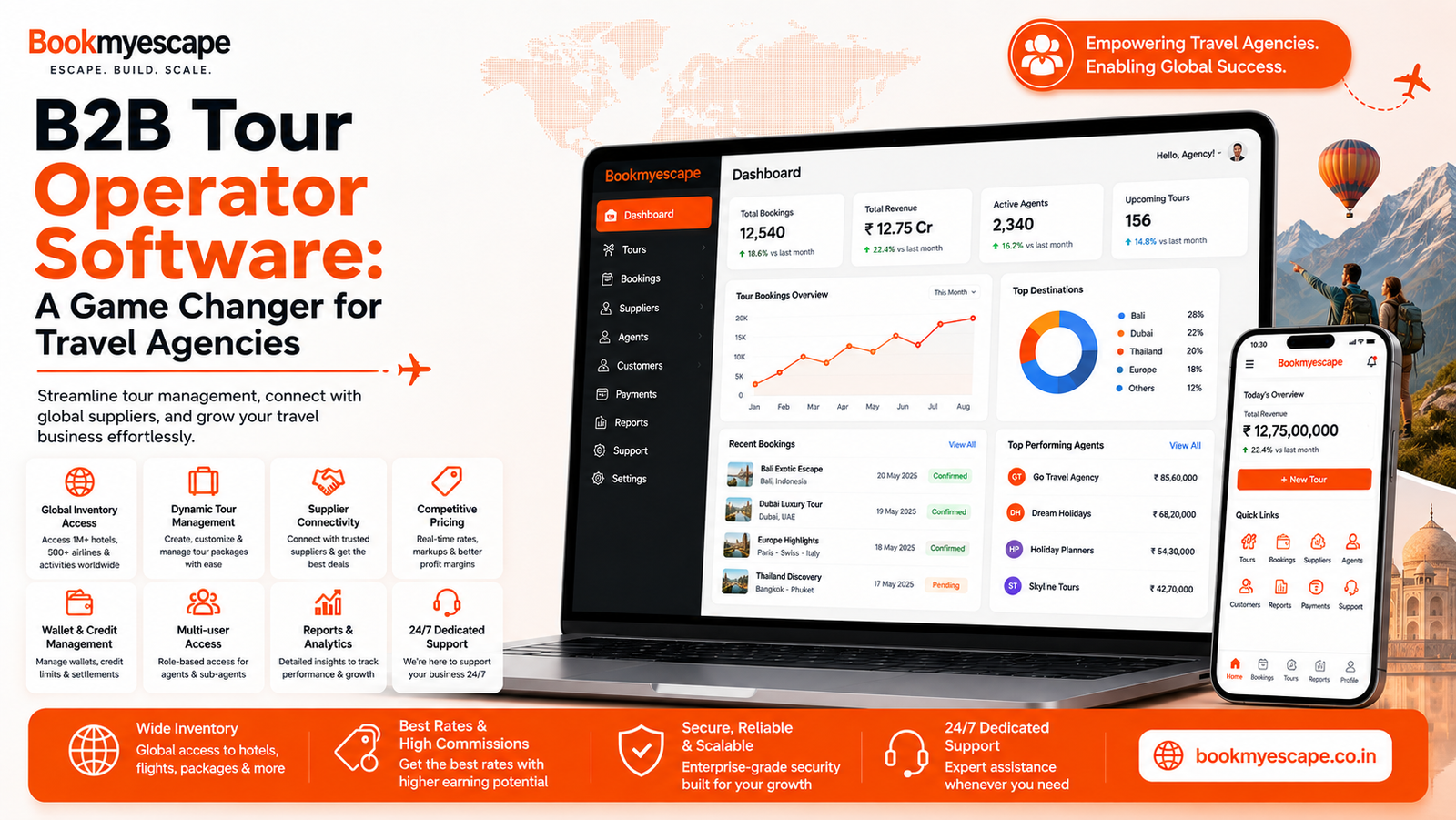
For a travel business, getting more travel agents should be a sign that things are really going well. More agents means more inquiries, more bookings and potentially a much larger customer base. But there is a point where growth starts creating a problem of its own. Every new agent can mean more emails and more quotation requests or even more booking confirmations and more follow-ups for your internal team. This is usually when your travel business might realize that the way you manage a network in the beginning might not work anymore. A team can handle a small number of partners through email or phone calls but when the network grows those same processes can become slow and even difficult to control. Your employees spend more time coordinating routine bookings and less time building valuable partner relationships. This is exactly where b2b tour operator software becomes useful. It gives you a structured digital environment where you can search travel products, check availability and bookings. You don’t have to depend on the internal team for every step. In simple terms the software is designed to help manage and distribute travel products Easily.
The real problem is not getting more agents- it’s managing them at scale
A strong agent network can be one of the most valuable assets your travel business can have. But the bigger that network becomes the harder it can be to manage every relationship manually. Think about a typical day at a busy tour operator. One agent wants a hotel quotation while another needs availability for a group. None of these tasks are unusual, that’s exactly the problem.
1. Increasing booking inquiries
As more agents start selling your products, booking inquiries actually increase. Your sales team might initially welcome every inquiry because it represents a potential booking. But when the same team has to manually respond to every request growth can quickly create pressure. A digital B2b channel allows agents to access information themselves for standard bookings.
2. Different rates for different partners
As a b2b travel business you rarely have a single price for everyone. One agent might receive a particular Commission arrangement while another one might work with negotiated markup while a larger partner might have a completely different commercial agreement. A properly designed software solution should therefore be evaluated not just on whether agents can make bookings but on how well the business can manage its commercial relationships.
3. Difficult measuring agent performance
Another problem appears when management wants to understand which partners are actually contributing to growth. Having 500 registered agents sounds really impressive but what if only 80 are producing bookings? Without proper reporting it can be difficult to see where the real business is coming from. A digital b2b system for travel agencies can truly give your business greater visibility into booking activity helping you identify productive agents and growing partners.
What changes when your agents can book through b2b travel agents software?
The biggest change is that routine transactions from employees lead to a more structured digital journey. That doesn’t mean every booking becomes completely self service.
Agent login and product discovery
The journey begins when your agent logs into the b2b tour operator software. Instead of contacting your sales team every time they want to know what’s available they can just access the products and services relevant to their account. Depending on the business this could include hotels, flights transfers and sightseeing.
Search compare and select
Once inside the portal agents can search for products based on their customers requirements. They can also compare available options and identify something suitable without waiting for your representative to prepare every detail manually.
Booking and confirmation
The next step is turning the selected product into a confirmed booking. Traditional B2B processes can involve several rounds of communication before a reservation is completed. The agent sends a request the operator checks availability and then another message might be required to complete the process. A digital booking workflow can reduce much of that back and forth for standard transactions.
Voucher and document access
Post booking administration is another area where agents can lose time. They might need a hotel voucher itinerary booking reference or other document for their customer. If every request comes back to the operations team, employees end up spending a lot of time retrieving and sending documents.
From agent relationship to Scalable distribution channel
There is a big difference between having a large database of travel agents and having a scalable B2B distribution network. A database tells you who your partners are and a distribution platform determines how effectively those partners can access and sell their products. This is exactly where the b2b system for travel agencies can become much more than just a booking tool.
1. From individual agent management to structure distribution
Traditional B2B operations often rely on salespeople. An agent sends an inquiry, someone checks the details and prepares a quotation. That model can work for Customized travel. But it becomes difficult to maintain when every simple transaction requires the same amount of human involvement. A digital model changes that balance. Your agents can handle routine bookings independently while your sales team focuses on more valuable activities like partner development.
2. Centralizing partner information
A growing network can become difficult to manage when information is spread across emails and spreadsheets. A centralized platform gives your business one place to manage agent accounts bookings pricing information and partner activity.
3. Self service does not mean less personal service
This is an important distinction. You might worry that giving your agents a self service portal will make relationships less personal. In practice it allows your team to spend more time on the relationships that actually need personal attention.
What should a travel business evaluate before choosing b2b travel agents software?
| Evaluation Area | Why It Matters |
| Agent Experience | Determines how easily partners can adopt and use the platform. |
| Supplier Connectivity | Influences the range of travel products available to agents. |
| Pricing Controls | Helps manage different partner rates, markups, and commercial arrangements. |
| Booking Workflow | Reduces unnecessary manual intervention in routine transactions. |
| Reporting | Helps identify productive, inactive, and growing partners. |
| Scalability | Allows the agent network to grow without creating the same level of operational pressure. |
| Integration Capability | Connects the B2B portal with suppliers and internal business systems. |
| Support | Helps minimize disruption when technical or operational problems occur. |
When does a travel agency actually need b2b tour operator software?
Not every travel business needs a b2b system for travel agencies from day one. But certain signs suggest that manual processes are beginning to hold the business back. You might be ready when you manage a growing number of travel agents and find that your team spends a large part of the day answering routine inquiries. You might notice that agents regularly ask for rates through email or WhatsApp even when the information is relatively standard. Your sales team might be preparing the same types of quotations repeatedly while booking information is spread across multiple systems. Another warning sign is when management struggles to answer basic questions about partner performance. Which agents are booking regularly? Which ones have stopped reducing business ? If your team wants to expand the agent network but knows that adding another 100 partners would require significantly more employees, that’s another strong indication that your operating model needs to change.
Choosing technology that supports your next stage of growth
The easiest mistake to make when buying b2b travel agents software is choosing something that solves today’s problems without considering tomorrow’s business. Think about where your travel company wants to be in 3 years. How many active agents do you expect to have? How many bookings will you process? Will you connect additional hotel or activity suppliers? These questions matter because your technology becomes part of your operating infrastructure. That doesn’t mean you should over buy technology today. It means that you should understand the difference between buying for immediate needs and choosing a platform with enough flexibility to support the direction of your business.
So B2B tour operator software from Bookmyescape is not valuable simply because it puts booking online; its real value comes from connecting the different parts of a travel distribution business. For a growing travel agency or consolidated the goal should not be to sign up more agents. The bigger goal is to build a network of productive agents that can generate more business without generating the same amount of additional administrative network.
Read More: Guide to Choosing the Right B2B Portal for Your Travel Agency
FAQ’S
1. What is B2B tour operator software?
B2B tour operator software is a digital platform that helps tour operators manage and distribute travel products to travel agents and business partners. It can centralize agent accounts, travel inventory, pricing, bookings, confirmations, vouchers, and partner activity, reducing the need for manual coordination.
2. How does B2B travel software help tour operators?
B2B travel software helps tour operators automate routine booking processes, give agents self-service access to travel products, manage partner-specific rates and markups, centralize booking information, and improve reporting. This allows internal teams to spend less time handling repetitive inquiries and more time developing agent relationships.
3. When should a tour operator use B2B software?
A tour operator should consider B2B software when its growing agent network creates more booking inquiries, quotation requests, rate enquiries, follow-ups, and administrative work. Other signs include heavy dependence on email or WhatsApp for routine bookings, difficulty tracking agent performance, and concerns that adding more agents will require significantly more staff.
4. Can B2B software manage different agent rates?
Yes, a B2B travel platform can be designed to manage different commercial arrangements for travel agents, including negotiated rates, markups, commissions, and partner-specific pricing rules. This gives tour operators greater control over pricing while allowing different agents to access the rates and products relevant to their accounts.
5. What features should B2B tour operator software have?
Important features include agent login and management, travel product search, supplier connectivity, booking and confirmation workflows, pricing and markup controls, voucher and document access, reporting and analytics, partner activity tracking, integrations, scalability, and technical support.
6. How does B2B software help travel agents?
B2B travel software gives agents self-service access to available travel products so they can search, compare, book, and retrieve booking documents without depending on the operator’s internal team for every routine transaction. This can speed up quotations and confirmations while making the overall booking process more efficient.