

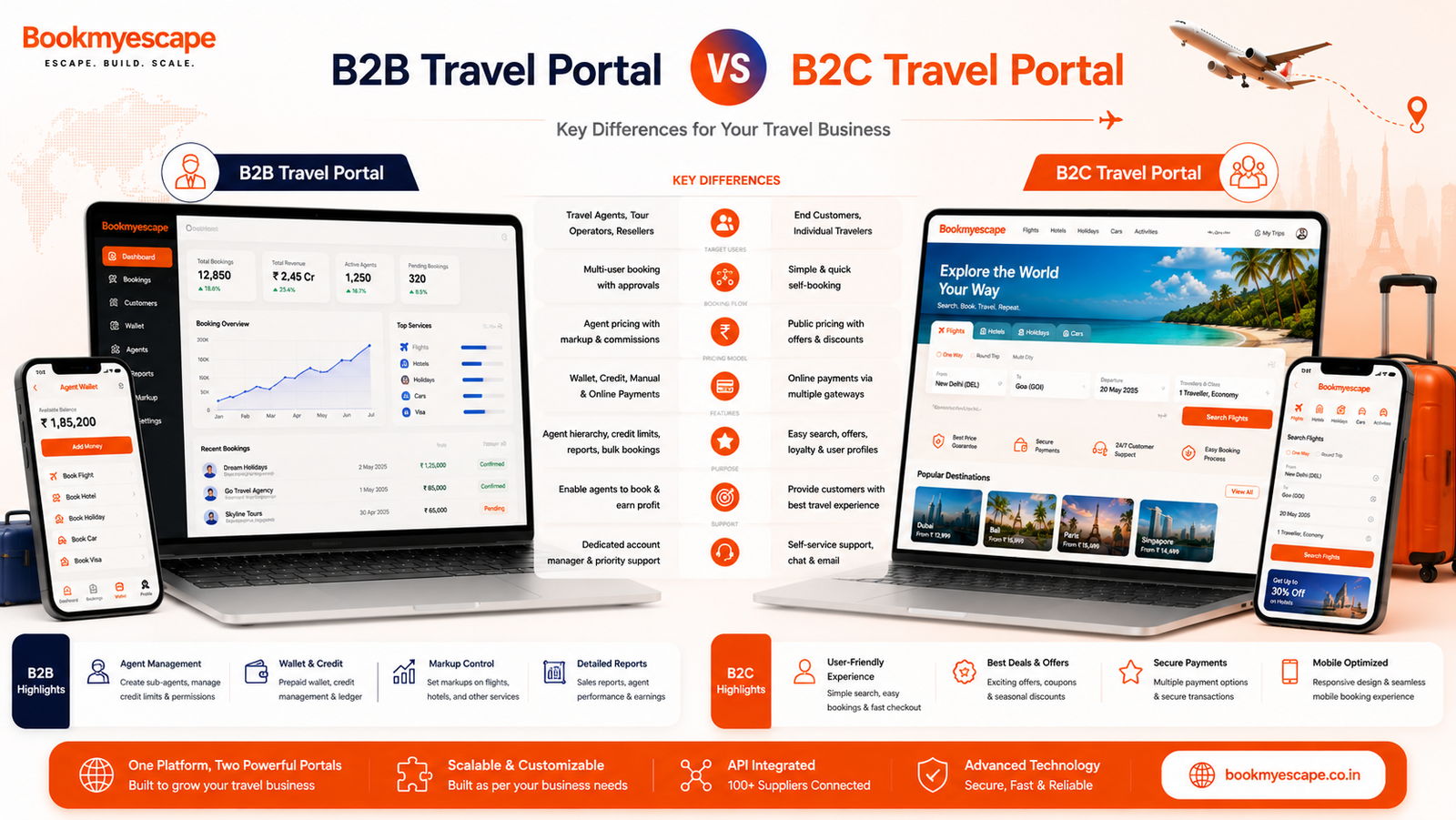
Growing the travel business is not just about adding more destinations or signing your suppliers. One of the biggest decisions you will make happens much earlier choosing how you want to sell. Do you want to build relationships with travel agents who look on behalf of their customers? Or do you want travelers to visit your website and book directly? Both the approaches have helped travel businesses build successful brands but they work in very different ways. The customers are different, the sales process is different even the technology behind each model is designed to solve different challenges. That’s why choosing between B2C Travel Portal and B2B Travel Portal should not be treated as a software decision alone. It’s a business strategy that influences everything from your customer acquisition and pricing to daily operations and future growth. The right choice depends on who you want to serve and how you plan to grow.
One industry two business models: understanding how travel companies sell
When travellers book a holiday they usually see only the final step. They search online, compare prices and make payments. What they don’t see is everything happening behind the scenes. Sometimes the booking comes directly from an OTA or travel company’s website. Other times it passes through a travel agent or a destination management company. That’s why the travel industry continues to rely on both B2B and B2C business models. B2C business portal allows you to sell directly to travelers. You are responsible for attracting visitors, creating a smooth booking experience and building long term customer loyalty.
B2B Travel portal is built around partnerships. Instead of focusing on individual travelers you work with travel agents and corporate clients who booked travel on behalf of their customers
Neither approach is replacing the other. In fact they complement each other. A destination management company might work with hundreds of travel agents across different countries while also accepting direct bookings through their website. A tour operator might have a dedicated B2B portal for partners and a separate B2C portal for retail customers.
Your customer changes everything
One of the biggest misconceptions is that the booking portal is simply a place where reservations happen. But in reality the portal reflects the behaviour of people using it. A travel agent books differently from someone planning a family holiday while a corporate travel manager has different priorities from a couple looking for a weekend escape.
B2B Travel portal is built around your business relationships
Travel agents don’t visit a booking portal to browse casually. They usually know what they are looking for, work within the client budget and compare supplier options. Speed matters but also flexibility. They might need access to negotiated pricing, the ability to generate quotations and tools that help them manage several customers at once. Once an agent trusts your platform they are likely to return again and again. Every successful booking strengthens that business relationship which is why B2B businesses often focus on retention as much as acquisition.
B2C Travel portal is built around convenience
Individual travellers approach booking very differently. They are exploring destinations, comparing pricing and weighing different options before making a decision. Their journey is influenced by emotions as much as price. A slow loading website confusing navigation or a complicated checkout process can easily push them towards another booking platform. That’s why you must invest heavily in intuitive search, mobile friendly design and secure payments and of course fast confirmations.
The booking journey looks very different in B2B and B2C Travel Portal
At first glance both the portals perform the same basic function. Someone searches for travel products, selects an option, makes a booking and receives confirmation. But if you look a little closer the journey is surprisingly different. In B2C travel portals the objective is to remove as many steps as possible. Your customers just want to search, compare and receive confirmation without needing assistance. Every extra click unnecessary form creates friction that might lead to abandoned booking.
B2B Travel Portal Follows a different region. A travel agent might search multiple options before preparing a quotation for a client. The customer might take a day or 2 to decide. Prices need adjustment; additional services could be added and approvals might be required before the booking is confirmed. Payments are often handled differently as well. No doubt retail customers usually pay online immediately but B2B businesses frequently work with credit arrangements, invoicing or agreed payment terms. Support also plays a different role. In B2C support is centred on helping individual travelers before and after the booking and in B2B support often focuses on helping travel agents manage multiple client bookings. Neither workflow is more complex than the other. They are simply designed to solve different business problems.
Strategy models: the growth Strategy behind each portal
Technology helps businesses process bookings but sets the revenue model that determines how those bookings contribute to long term growth.
A B2B Travel portal grows by expanding its network of travel agents and distribution partners. Instead of acquiring thousands of individual customers the focus is on building long term relationships with businesses that generate bookings consistently. Revenue often comes through negotiated markups and supplier commissions.
A B2C travel portal follows a different path. Here every visitor is a potential customer. The objective is not just to secure the booking but also maximize the value of that customer throughout their journey. Many businesses also invest in loyalty programs and customized offers to encourage repeat bookings and strengthen long term customer relationships.
B2B and B2C Travel Portal: At a Glance
| Business Area | B2B Travel Portal | B2C Travel Portal |
| Primary Users | Travel agents, corporate clients, and business partners | Individual travellers |
| Sales Process | Relationship-driven and partner-focused | Self-service online booking |
| Pricing Model | Negotiated rates, commissions, and markups | Public retail pricing and promotional offers |
| Customer Journey | Assisted booking process | Independent online booking |
| Payment Process | Credit accounts, invoicing, deposits | Instant online payments |
| Marketing Focus | Building partner networks | Attracting and retaining travellers |
| Business Goal | Expand distribution through partners | Increase direct online bookings |
| Best Fit | DMCs, wholesalers, consolidators, B2B travel companies | OTAs, travel agencies, travel brands |
Can one travel business successfully operate both models?
In fact many of today’s successful travel companies don’t limit themselves to either B2B or B2C Travel Portal . They combine both the approaches to create multiple revenue streams and reduce dependence on a single sales channel. Consider a destination management company that works with travel agents across Europe while also accepting direct bookings from travelers through their own websites. Or even consider a tour operator that sells only holiday packages to consumers while giving travel agents access to exclusive partner pricing through a dedicated portal. In both the cases the business reaches different customer segments without changing core travel products. There are clear advantages to this hybrid approach.
So there is no one universal winner in the debate between B2B and B2C Travel Portal because they are built to achieve different business objectives. A B2B Model is ideal for you if you want to grow through your travel agents distribution partners and long term business relationship. B2C Model is designed for you if you want to build direct relationships with travelers. It focuses on delivering an exceptional online booking experience increasing customer loyalty and creating more opportunities for direct sales. To select the right portal for your business you can connect with experts today at Bookmyescape.
Read More: Where to Find the Best B2C Travel Portal Software Options?
FAQ’S
1. Which is better: a B2B travel portal or a B2C travel portal?
There is no single best option because the right portal depends on your business goals. A B2B travel portal is ideal for companies that want to grow through travel agents, corporate clients, and distribution partners, while a B2C travel portal is designed for businesses that sell directly to travelers. Many successful travel companies eventually adopt both models to increase revenue, expand market reach, and reduce dependence on a single sales channel.
2. Can one travel website support both B2B and B2C bookings?
Yes. A modern travel platform can support both B2B and B2C bookings from a single system by offering separate user logins, pricing rules, commissions, payment methods, and booking workflows. This allows travel businesses to serve travel agents, corporate clients, and individual travelers efficiently while managing operations through one centralized platform.
3. What features should a B2B travel portal include?
A B2B travel portal should include travel agent registration, negotiated pricing, commission and markup management, credit limits, quotation generation, invoicing, booking reports, supplier API integrations, multi-currency support, and role-based access. These features help travel businesses streamline partner management, improve booking efficiency, and strengthen long-term relationships with travel agents.
4. What features should a B2C travel portal have?
A successful B2C travel portal should offer real-time search, live pricing, secure online payments, mobile-friendly booking, customer accounts, travel API integration, multilingual and multi-currency support, promotional offers, and a simple checkout experience. These features help improve customer satisfaction, increase online bookings, and encourage repeat business.
5. How do B2B and B2C travel portals generate revenue?
B2B travel portals generate revenue through negotiated commissions, markups, supplier agreements, and long-term partnerships with travel agents, while B2C travel portals earn through direct customer bookings, service fees, promotional packages, dynamic pricing, cross-selling, and loyalty-driven repeat bookings. Businesses operating both models can create more stable and diversified revenue streams.
6. Who should invest in a B2B and B2C travel portal?
A combined B2B and B2C travel portal is ideal for destination management companies (DMCs), online travel agencies (OTAs), tour operators, wholesalers, consolidators, and growing travel businesses that want to serve both travel agents and direct customers. Operating both models enables businesses to expand their distribution network, improve operational efficiency, and maximize booking opportunities across multiple customer segments.