

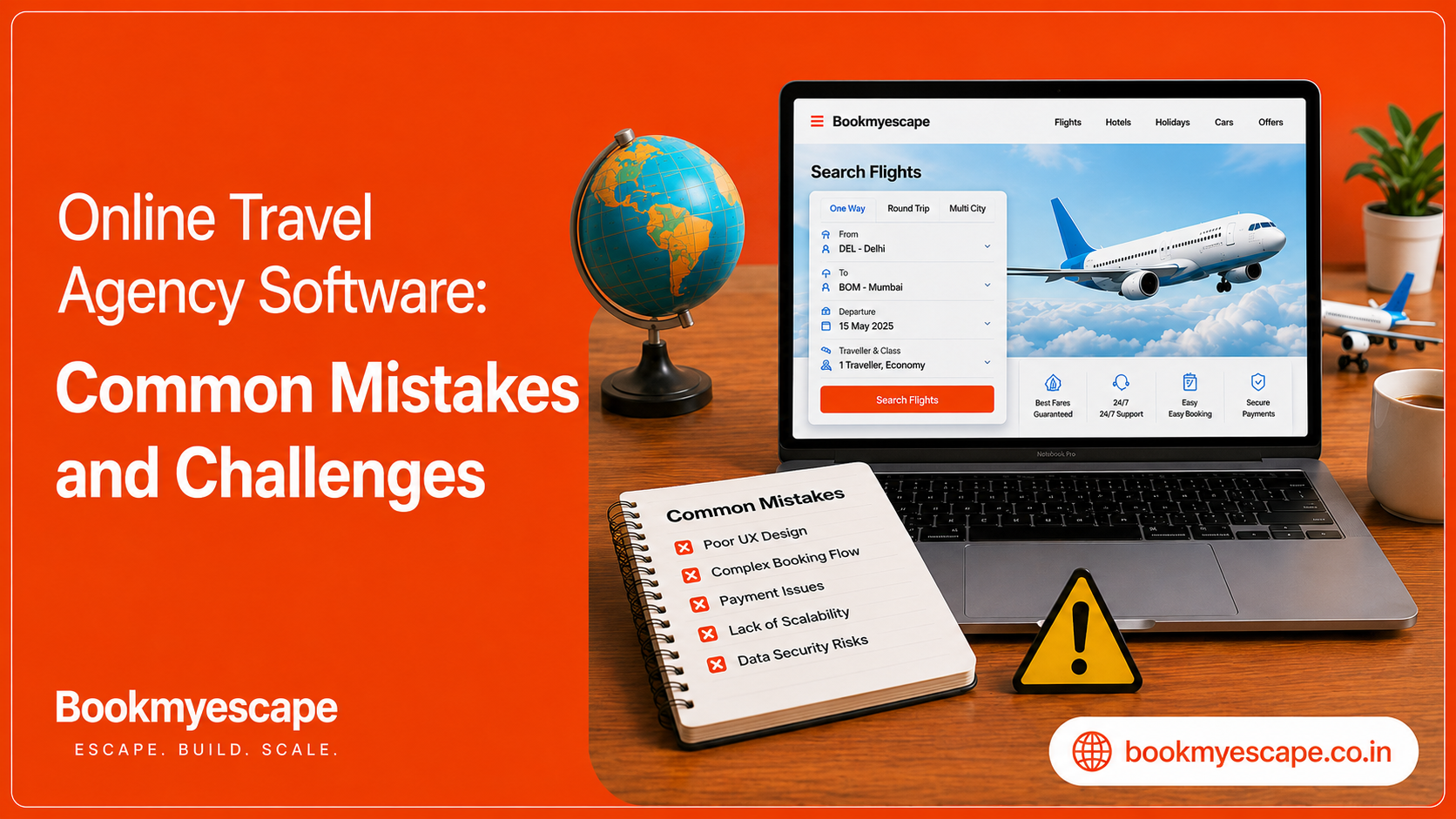
The global travel industry is becoming increasingly digital, and businesses are investing heavily in Online Travel Agency Software to automate bookings, manage inventory, connect suppliers, and improve customer experiences.
Whether you’re a travel agency, tour operator, DMC, startup OTA, or an established travel business, selecting the right OTA Platform can significantly impact your growth, profitability, and operational efficiency.
However, many businesses focus only on attractive demos, supplier logos, and feature lists while overlooking critical operational, technical, and commercial factors.
The result?
Costly implementation failures, unexpected operational challenges, poor customer experiences, and expensive platform migrations.
This article explores the most common mistakes and challenges organizations face when selecting an Online Travel Booking System and provides practical guidance to help decision-makers make informed technology choices.
Why Choosing the Right OTA Platform Matters
Modern travelers expect:
- Real-time availability
- Accurate pricing
- Instant confirmations
- Mobile-friendly booking experiences
- Fast refunds and cancellations
- Secure payment processing
To meet these expectations, an OTA Platform must do far more than display flights or hotels.
A modern Online Travel Agency Software solution acts as the operational backbone of the business by managing:
- Supplier integrations
- Inventory aggregation
- Booking workflows
- Payments
- Reporting
- Customer support
- Reconciliation
- Compliance requirements
Choosing the wrong system often creates long-term operational bottlenecks that become increasingly expensive as the business scales.
Mistake 1: Choosing Software Based on Features Instead of Business Model
One of the biggest mistakes companies make is selecting an Online Travel Booking System based on features rather than business requirements.
Many vendors advertise:
- Flight booking
- Hotel booking
- Packages
- Activities
- Payment gateways
While these features are important, they do not determine whether the platform supports your business model.
Before evaluating any OTA Platform, businesses should clearly define:
Are you operating as:
- B2C OTA
- B2B travel wholesaler
- B2B2C marketplace
- Corporate travel provider
- Affiliate travel business
- DMC
- Tour operator
Each model requires different workflows, permissions, markups, payment structures, and customer support responsibilities.
A platform designed primarily for B2C sales may struggle to support:
- Agent credit systems
- Multi-level markups
- Agency hierarchies
- Corporate travel policies
- White-label partner management
This mismatch often becomes apparent only after implementation.
Mistake 2: Overestimating Supplier Connectivity
Many travel software providers advertise access to hundreds of suppliers.
However, supplier quantity does not always equal supplier quality.
When evaluating Online Travel Agency Software, businesses should verify:
- Which suppliers are actually live
- Regional supplier coverage
- API reliability
- Data accuracy
- Response times
- Supplier support quality
Questions to ask include:
- Are these integrations currently active?
- Are production credentials available?
- Do reference customers use these integrations?
- What happens when supplier APIs change?
An OTA Platform is only as strong as the quality of its supplier ecosystem.
Mistake 3: Ignoring Hotel Mapping and Content Normalization
Hotel inventory aggregation is far more complex than many businesses realize.
The same hotel may appear through multiple suppliers using:
- Different IDs
- Different room names
- Different descriptions
- Different images
- Different pricing structures
Without proper hotel mapping, an Online Travel Booking System may display:
Problems such as:
- Duplicate hotels
- Inconsistent room information
- Confusing search results
- Incorrect pricing comparisons
This negatively affects user experience and conversion rates.
Modern OTA Platforms require robust mapping solutions and content normalization processes to ensure clean inventory presentation.
Mistake 4: Underestimating the Booking Lifecycle
Many travel businesses focus heavily on search and booking.
However, the real complexity begins after a booking is made.
A complete Online Travel Agency Software solution should support:
Pre-booking
- Search
- Filtering
- Price validation
- Availability checks
Booking
- Reservation creation
- Payment processing
- Confirmation generation
Post-booking
- Amendments
- Cancellations
- Refunds
- Name corrections
- Voucher regeneration
- Customer communication
A system that performs well during booking but struggles with post-booking operations creates significant support burdens.
Mistake 5: Misunderstanding Payment Responsibilities
Payments are among the most overlooked areas when selecting an OTA Platform.
Travel businesses often fail to determine:
- Who collects payment?
- Who processes refunds?
- Who handles disputes?
- Who owns chargeback risk?
Different models include:
1. Merchant Model
The OTA collects payment directly from customers.
2. Agency Model
The supplier collects payment.
3. Hybrid Model
Payment responsibility varies by supplier.
Each approach affects:
- Cash flow
- Accounting
- Compliance
- Customer support
Without clear payment ownership, operational challenges increase significantly.
Mistake 6: Ignoring Multi-Currency and Foreign Exchange Challenges
International travel businesses frequently support multiple currencies.
Many Online Travel Booking Systems display localized prices but fail to properly manage:
- Supplier billing currency
- Customer display currency
- Settlement currency
- Refund currency
This creates:
- Margin leakage
- Reconciliation issues
- Customer disputes
- Unexpected FX losses
Businesses should evaluate how an OTA Platform handles currency conversion across the entire booking lifecycle.
Mistake 7: Treating Refunds and Chargebacks as Secondary Features
Refund management is often more complicated than booking creation.
A strong Online Travel Agency Software solution should provide:
- Refund tracking
- Cancellation status monitoring
- Chargeback workflows
- Evidence collection
- Audit trails
Without these capabilities, customer support teams spend excessive time manually resolving disputes.
Over time, this increases operational costs and damages customer trust.
Mistake 8: Ignoring Scalability Requirements
Many travel startups choose software that works well for a few hundred bookings per month.
Problems emerge when traffic grows.
Scalability challenges often include:
- API rate limits
- Slow search responses
- Booking failures
- Inventory synchronization delays
- Database bottlenecks
Before selecting an OTA Platform, businesses should understand:
- Search volume limits
- Concurrent booking limits
- Infrastructure architecture
- Supplier throttling policies
Scalability should be evaluated before growth occurs—not after.
Mistake 9: Overlooking Security and Compliance
Travel businesses handle:
- Personal information
- Passport details
- Payment data
- Loyalty accounts
- Travel documents
A secure Online Travel Booking System should support:
Security Requirements
- PCI DSS compliance
- SSL encryption
- Secure authentication
- Role-based access controls
- Data encryption
Ignoring security considerations can expose businesses to regulatory penalties and reputational damage.
Mistake 10: Prioritizing Features Over User Experience
A feature-rich platform does not automatically create a great customer experience.
Today’s travelers expect:
- Fast page loading
- Mobile optimization
- Clear pricing
- Simple checkout flows
- Transparent cancellation policies
Common UX mistakes include:
- Too many booking steps
- Hidden fees
- Slow mobile performance
- Confusing filters
- Poor navigation
Even a technically advanced OTA Platform can struggle if the user experience is poor.
Common OTA Software Mistakes and Their Impact
| Mistake | Result |
| Choosing based on demo | Platform mismatch |
| Ignoring supplier quality | Poor inventory |
| Weak mapping strategy | Duplicate hotels |
| No refund workflow | Support overload |
| Ignoring scalability | Slow searches |
| Weak compliance | Security risks |
| No reconciliation process | Revenue leakage |
| Poor mobile UX | Lower conversions |
Common Operational Challenges After Launch
Many travel companies assume implementation marks the end of the project.
In reality, operational challenges continue long after launch.
Common issues include:
Inventory Management
- Duplicate listings
- Availability mismatches
- Stale content
Supplier Management
- API updates
- Contract changes
- Connectivity issues
Customer Support
- Cancellation requests
- Refund disputes
- Booking modifications
Finance Operations
- Reconciliation
- Commission calculations
- FX adjustments
Successful travel businesses plan for these operational requirements from the beginning.
Good vs Bad OTA Platform
| Capability | Poor OTA Software | Strong OTA Software |
| Supplier APIs | Limited | Multi-supplier |
| Hotel Mapping | Manual | Automated |
| Payments | Basic | Multi-model |
| Refunds | Manual | Automated |
| Reporting | CSV only | Real-time |
| Scalability | Limited | Enterprise-ready |
| Mobile UX | Average | Optimized |
| Security | Basic | PCI Ready |
How AI and Search Are Changing OTA Software Selection
The rise of AI-powered search engines is changing how travel technology is evaluated.
Travel businesses must now consider visibility across:
- Google AI Overviews
- ChatGPT
- Perplexity
- Gemini
- Voice search platforms
This means OTA Platforms should support:
Structured Content
Clear hotel, flight, package, and destination information.
Fast Performance
Speed remains critical for SEO and user experience.
Content Scalability
Large travel inventories require organized, searchable content.
Semantic Relevance
Information should answer traveler questions directly.
Businesses choosing Online Travel Agency Software today should think beyond bookings and consider how their platform supports future discoverability across AI-driven search environments.
Questions Every Business Should Ask Before Selecting an OTA Platform
Before signing any software agreement, decision-makers should ask:
1. Business Fit
- Does the platform support our operating model?
2. Supplier Coverage
- Are our required suppliers already integrated?
3. Booking Lifecycle
- Can it manage cancellations and amendments efficiently?
4. Payment Management
- How are refunds and disputes handled?
5. Scalability
- Can it support future booking growth?
6. Security
- What compliance certifications exist?
7. Reporting
- Can finance reconcile transactions easily?
8. Vendor Independence
- How easy is future migration if needed?
The answers to these questions often reveal more than a product demonstration ever will.
Choosing the Right Online Travel Agency Software for Long-Term Growth
Selecting the right Online Travel Agency Software is not simply a technology decision it is a business strategy decision. Many travel businesses focus on attractive interfaces and extensive feature lists while overlooking critical operational realities such as supplier connectivity, payment ownership, reconciliation, scalability, security, and post-booking servicing. The most successful organizations evaluate an OTA Platform based on how well it supports their complete business model rather than how impressive it looks during a demo. A reliable Online Travel Booking System should simplify operations, improve customer experiences, support future growth, and reduce operational complexity not create new challenges after launch.
Modern travel platforms such as Bookmyescape demonstrate how a well-structured OTA Platform can bring together supplier connectivity, booking management, payment processing, and customer experience within a single ecosystem. However, regardless of the platform selected, the underlying focus should always be on operational efficiency, scalability, and long-term business requirements. As the travel industry becomes increasingly competitive and AI-driven search continues to evolve, businesses that make informed technology decisions today will be better positioned to scale, adapt, and succeed in the years ahead.
“Read More: A Comprehensive Guide for Using Bookmyescape as a Travel Agency“
FAQ’S
1. What is the most important factor when choosing Online Travel Agency Software?
The most important factor when selecting Online Travel Agency Software is ensuring the platform aligns with your business model rather than simply choosing the solution with the most features. A travel agency, OTA, DMC, corporate travel company, or B2B wholesaler all have different operational requirements, supplier workflows, markup structures, and customer management needs. The right OTA platform should support your current operations while providing scalability for future growth.
2. Why do OTA platforms fail after implementation?
Many OTA platform implementations fail because businesses focus on demos, feature lists, and supplier counts without evaluating operational requirements such as booking lifecycle management, supplier reliability, refund workflows, reconciliation processes, scalability, and customer support operations. These issues often become visible only after launch, leading to higher costs, operational bottlenecks, and poor customer experiences.
3. How does supplier connectivity impact an OTA booking system?
Supplier connectivity directly affects the quality of inventory, pricing accuracy, booking reliability, and customer satisfaction. A strong Online Travel Booking System should integrate with reliable suppliers that provide real-time availability, stable APIs, accurate content, and consistent support. The value of an OTA platform depends more on supplier quality and reliability than the number of supplier logos displayed during sales presentations.
4. Why is hotel mapping important in OTA software?
Hotel mapping is essential because the same hotel can appear from multiple suppliers using different names, room descriptions, images, and identifiers. Without proper hotel and room mapping, customers may see duplicate listings, inconsistent content, confusing pricing, and poor search results. Effective hotel mapping improves user experience, inventory quality, and booking conversion rates.
5. How can travel businesses future-proof their OTA platform investment?
Travel businesses can future-proof their OTA software investment by selecting a scalable platform that supports multi-supplier connectivity, flexible payment models, automated refunds, advanced reporting, security compliance, API-driven architecture, and AI-search readiness. A future-ready OTA platform should be capable of handling increasing booking volumes, new suppliers, and changing customer expectations without requiring major system replacements.
6. How does AI search impact Online Travel Agency Software selection?
AI-powered search engines such as ChatGPT, Google AI Overviews, Gemini, and Perplexity are changing how travelers discover travel products online. Modern OTA platforms should support structured travel content, fast page performance, searchable inventory, semantic content organization, and mobile-friendly experiences. These capabilities improve visibility across AI-driven search platforms while helping travel businesses attract more qualified traffic and bookings.